Why Tax Delinquent Properties Deserve Your Attention
!Texas tax delinquent properties — the overlooked goldmine in 230,000+ county records

Source: Texas Signals — aggregate county data.
Every real estate investor knows about pre-foreclosures. It's the first signal type most people learn about. But here's what experienced investors know: tax delinquent properties are often better leads than pre-foreclosures, and the competition is significantly lower.
Why? Because most investors are fixated on the dramatic timeline of foreclosure — the auction countdown, the courthouse steps. Meanwhile, tax delinquency is a slow-burning signal. A homeowner might be 2, 3, even 5+ years behind on property taxes before the county takes action. That's a long window of motivated ownership.
And the motivation is real. In Texas, unpaid property taxes accrue penalty fees that can reach 47% of the original tax bill. The county will eventually file a tax lien, and if it goes unresolved, the property gets sold at a tax sale. These homeowners know the clock is ticking — they just don't always know what to do about it.
How Texas Property Taxes Work (Quick Primer)
Before we talk strategy, let's make sure the fundamentals are solid.
In Texas, property taxes are assessed annually by your county's Central Appraisal District (CAD). The CAD determines the property's appraised value. Then the various taxing entities — county, city, school district, special districts — apply their tax rates.
Key dates:
•January 1 — the "assessment date" (the value is based on what the property is worth on this date)
•October 1 — tax bills are typically mailed
•January 31 — taxes are due (the following year)
•February 1 — taxes become delinquent if unpaid
The Penalty Escalation
This is where it gets painful for property owners. Starting February 1:
•February: 6% penalty + 1% interest
•March: 7% penalty + 2% interest
•April: 8% penalty + 3% interest
•May: 9% penalty + 4% interest
•June: 10% penalty + 5% interest
•July 1: an additional 20% collection penalty if referred to a delinquent tax attorney — bringing the total potential penalty to 41% + interest
By the time a property is a few years delinquent, the total owed can be 40-50% more than the original tax bill. On a $5,000 annual tax bill, that's an additional $2,000-$2,500 in penalties and interest — every year.
Tax Delinquency as an Investment Signal
So what does tax delinquency tell you about a property owner? A few things:
1. Cash Flow Problems
The simplest explanation. They don't have the money to pay their taxes. This could be temporary (medical emergency, job loss) or structural (fixed income that doesn't keep up with rising property values).
2. Absentee Ownership
Many tax-delinquent properties are owned by absentee landlords who inherited the property, moved away, or simply lost interest. They may not even realize they're delinquent until they get a letter from the county attorney.
3. Life Transitions
Death of a spouse, divorce, moving to assisted living — life changes often lead to unpaid bills. The property becomes a burden they don't know how to deal with.
4. The Property Itself Is a Problem
Sometimes the property has maintenance issues so severe that the owner has effectively abandoned it. They might still hold the title, but they've stopped investing in the property — including paying taxes.
Source: Texas Signals — aggregate county data.
How to Evaluate a Tax Delinquent Lead
Not every tax-delinquent property is a deal. Here's how to filter:
Amount Owed vs. Property Value
This is your equity check. If someone owes $3,000 in back taxes on a property worth $250,000, there's plenty of equity for a deal. If they owe $15,000 on a property worth $40,000, the margins are tight.
Years Delinquent
More years = more motivation. A property that's 1 year delinquent might just be a late payer. A property that's 4+ years delinquent suggests a deeper problem — and a more motivated seller.
Property Condition
Use Google Street View, drive by if local, or check for code violations. Tax-delinquent properties in good condition with an absentee owner? That's your best-case scenario — the owner just needs a reason to let go.
Ownership Type
Individual owners are easier to work with than LLCs, trusts, or estate properties. If the owner is deceased and the property is in probate, you'll need to navigate additional legal complexity.
Strategy 1: Direct Purchase from the Owner
The most straightforward approach. You:
1.Identify tax-delinquent properties using Texas Signals
2.Skip trace the owner's contact information
3.Reach out with a clear, empathetic message
4.Make a fair cash offer
5.Close the deal and pay off the back taxes at closing
Your pitch to the owner: "I know you have some back taxes on the property. I can take care of those at closing — you walk away with cash in your pocket and no more tax bills."
For many owners, the relief of not having to deal with the property anymore is worth more than maximizing the sale price.
Strategy 2: Tax Lien Investing
Texas is a tax deed state (not a tax lien certificate state), but the process is worth understanding.
When a county files a tax suit and wins a judgment, the property goes to auction:
•The minimum bid is the amount of back taxes, penalties, interest, and court costs
•If no one bids, the county can "strike off" the property to itself
•Properties that don't sell at the regular auction end up in the county's resale inventory, where they can be purchased for as little as the minimum bid
The Redemption Period
This is critical. Unlike mortgage foreclosure, tax foreclosure in Texas includes a right of redemption:
•Homestead and agricultural properties: the former owner has 2 years to redeem (pay back the taxes, penalties, and a 25% premium to the buyer)
•All other properties: 6 months to redeem (with a 25% premium)
That 25% premium is effectively your guaranteed return if the owner redeems. If they don't redeem, you own the property free and clear.
Strategy 3: Wholesaling Tax Delinquent Properties
If you don't want to buy and hold, you can wholesale:
1.Get the tax-delinquent property under contract at a discount
2.Find an end buyer (investor, rehabber) willing to pay more
3.Assign the contract and pocket the difference
Tax-delinquent properties are especially good for wholesaling because:
•The seller is motivated (they need the tax problem to go away)
•The buyer gets a property with a clear, fixable title issue
•The assignment fee comes from the spread between your contract price and the end buyer's price
Finding Tax Delinquent Properties in Texas
The traditional way is painful: visit each county's tax assessor website, download spreadsheets, cross-reference with property records, and manually filter. Across 209 counties, that's a full-time job.
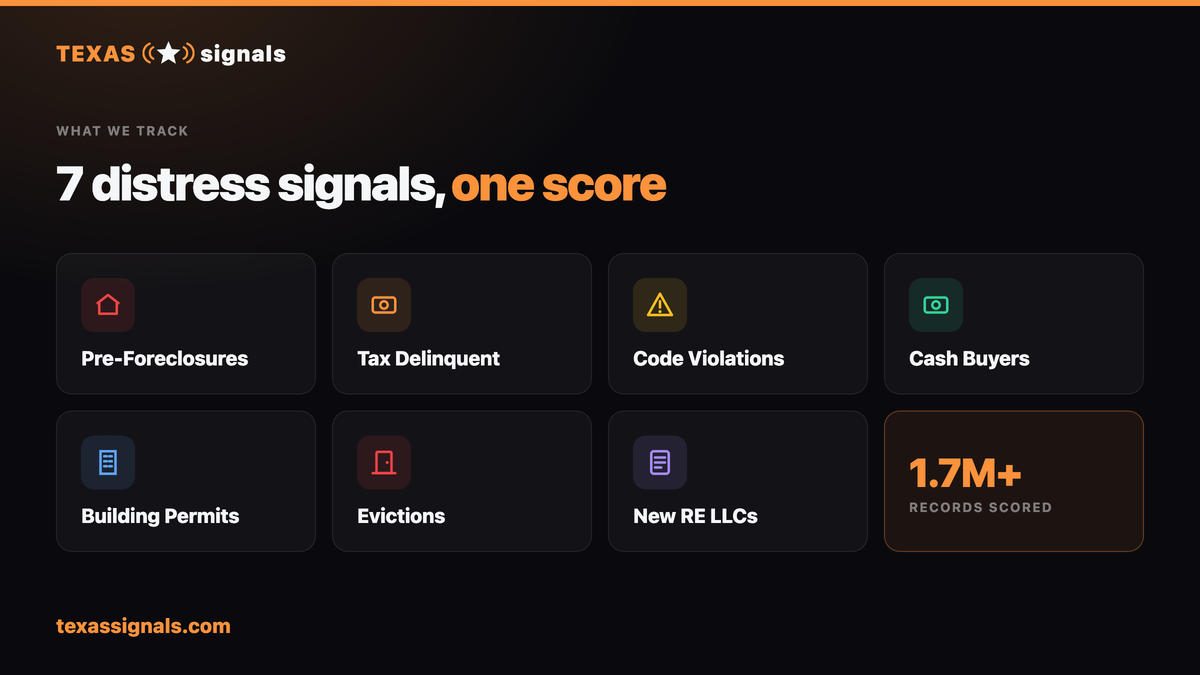
Texas Signals aggregates 230,000+ tax delinquent records across Travis, Harris, Dallas, Bexar, Tarrant, Collin, and Denton counties. Each record includes:
•Property address
•Owner name
•Amount owed
•Years delinquent
•Assessed value (when available)
•Estimated equity
•CAD structural data (lot size, year built, square footage)
•Geocoded location for map analysis
Filter by city, ZIP code, minimum lot size, or sort by equity spread. Export to CSV for skip tracing.
Bottom Line
Tax delinquent properties are the tortoise in the Aesop's fable — they're not as flashy as pre-foreclosures, but they win more races than you'd expect. The competition is lower, the timelines are longer (giving you more room to work), and the motivation is real.
The best investors stack multiple signals. A tax-delinquent property with a code violation in a gentrifying ZIP code? That's not just a lead — that's a deal waiting to happen.
!Texas Signals by the numbers — tax delinquent records, pre-foreclosure filings, cash buyer activity

Source: Texas Signals — aggregate county data.