One Property, Eight Possible Signals
Every property in Texas is one filing away from appearing in our database. A missed mortgage payment leads to a Notice of Default. Unpaid property taxes accumulate and get flagged in county records. A complaint to code enforcement triggers a violation record. A landlord files for eviction. An investor forms a new LLC to acquire in the area.
None of these signals are secret. They're all public records. What's hard is aggregating them across 213 counties in real time, cleaning and normalizing them into a consistent schema, and surfacing them in a way that lets investors act quickly.
Texas Signals tracks 7 distinct signal types. Here's what each one means, where the data comes from, and how investors use it.
!Texas Signals — 8 Signal Types
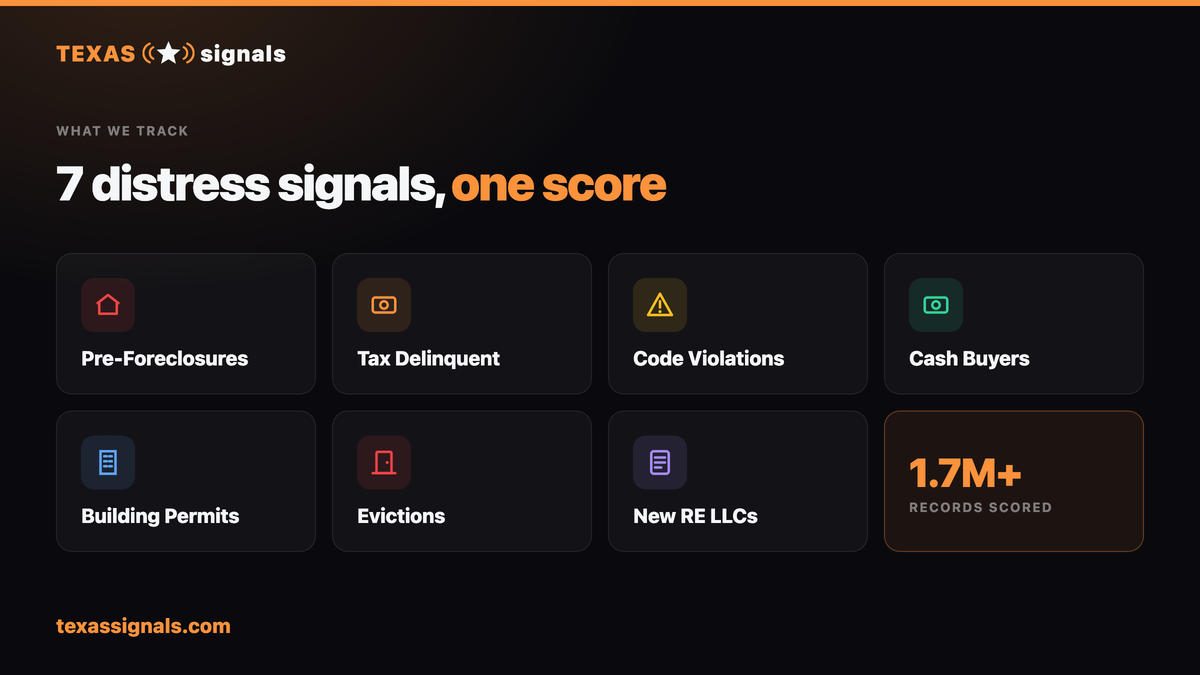
Source: Texas Signals — aggregate county data.
Signal 1: Pre-Foreclosures
What it is: A legal filing indicating that a property owner has defaulted on their mortgage and the lender has initiated the foreclosure process.
Where we get it: County clerk recordings. In Texas, non-judicial foreclosures proceed through a Notice of Default followed by a Notice of Sale filed with the county. These are public records.
What it tells you: The owner has a firm legal timeline. Unlike most distress signals, pre-foreclosure comes with a deadline — if the owner doesn't reinstate, sell, or negotiate a resolution, the property goes to auction. That timeline creates urgency that doesn't exist in other signal types.
How investors use it: Pre-foreclosure is the highest-conversion distress signal for cash acquisition. Reach out before the Notice of Sale is filed — ideally within 1–2 weeks of the Notice of Default — and you'll be talking to an owner who is stressed but still has meaningful options. After the Notice of Sale, the timeline is very short and competition is intense.
Signal 2: Tax Delinquent Properties
What it is: A property with outstanding ad valorem property tax obligations owed to the county, city, or school district.
Where we get it: County tax assessor-collector records and the Texas Comptroller's property tax delinquency data. Most Texas counties publish delinquent tax rolls as public records.
What it tells you: The owner is either financially stressed, disengaged from the property, or both. Texas tax delinquency compounds quickly — the state adds a 6% penalty plus interest in the first year, with additional penalties in subsequent years. By year three or four, a modest tax obligation can grow to a significant sum.
How investors use it: Tax delinquent leads are typically slower to convert than pre-foreclosure leads — there's less urgency because the county's enforcement timeline is longer. But they're often less competitive because fewer investors work them systematically. Properties with multiple years of delinquency and low equity are strong candidates for short-sale negotiations or deed-in-lieu arrangements.
Signal 3: Code Violations
What it is: A formal violation notice issued by a city or county code enforcement department for conditions including structural disrepair, overgrown vegetation, unpermitted construction, junk vehicles, or habitability issues.
Where we get it: Municipal and county code enforcement records. Availability varies by jurisdiction — major Texas cities publish these records; smaller municipalities have inconsistent reporting.
What it tells you: The owner has either lost interest in the property, lacks the resources to maintain it, or is dealing with a difficult tenant situation. Code violations often correlate with other distress signals — properties with violations frequently also have tax delinquencies or permit issues.
How investors use it: Code violations alone rarely produce immediate motivated sellers, but they're a strong secondary signal when combined with pre-foreclosure or tax delinquency. A property with an active code violation and a Notice of Default is a high-priority lead. Code violation data also surfaces off-market properties in neighborhoods where nothing is currently listed.
Signal 4: Cash Buyer Transactions
What it is: A recorded deed transfer where the consideration was paid in cash — no mortgage lien recorded simultaneously with the deed.
Where we get it: County deed records. We parse grantor-grantee indices to identify transfers without corresponding deed of trust recordings, which indicates cash purchases.
What it tells you: Who is actively buying in a given market, at what price points, and in what property types. Cash buyer data is a lagging indicator — by the time it appears, the transaction has already closed — but it builds an accurate picture of who the active investors in any county are.
How investors use it: Cash buyer lists are used for wholesaler buyer lists, JV partner identification, and competitive intelligence. Pair cash buyer data with the New LLC feed to identify buyers who formed entities recently but haven't closed yet — those are the freshest relationship opportunities.
Signal 5: Permit Activity
What it is: A building permit application or approval for construction, renovation, addition, or demolition activity on a property.
Where we get it: City and county building departments. Major Texas metros publish permit data via open data portals or direct feeds.
What it tells you: Permit data is primarily an opportunity signal rather than a distress signal. Active renovation permits indicate investor activity — either an owner doing improvements before listing or an investor already working the property. A surge in permits in a specific neighborhood can indicate appreciation momentum.
How investors use it: Permit data has two primary uses. First, identifying active renovators who may be prospective buyers for your wholesale deals. Second, competitive intelligence — if you're tracking a specific block for acquisition, permit activity tells you whether another investor has already engaged the area.
Signal 6: Eviction Filings
What it is: A JP court filing by a landlord to remove a tenant, typically for nonpayment of rent or lease violations.
Where we get it: Texas Justice of the Peace court records. JP courts handle forcible entry and detainer (eviction) cases in Texas and maintain public docket records.
What it tells you: A landlord who has filed for eviction is experiencing at minimum a short-term cash flow problem. Multiple eviction filings, or a pattern of filings across multiple properties, may indicate a landlord who is struggling with their portfolio and considering an exit.
How investors use it: Eviction data is primarily useful for identifying distressed landlords who own rental properties. A landlord with three eviction filings in the past 12 months across two properties in the same county is a very different prospect than a first-time eviction. Subject-to and creative financing conversations often work well with stressed landlords who have equity but cash flow problems.
Signal 7: New Real Estate LLCs
What it is: A newly formed Texas LLC verified through both the Secretary of State and the Comptroller's Taxable Entity Search, classified as operating in real estate acquisition, holding, or management.
Where we get it: Texas Secretary of State formation records, cross-referenced against the Texas Comptroller's Taxable Entity Search for active status and business classification. For a detailed explanation of our verification process, see How Texas Signals Verifies New LLCs with the Comptroller's Taxable Entity Search.
What it tells you: Someone formed a real estate entity in your market. They have intent and a vehicle for transacting. They have not yet closed their first deal in Texas.
How investors use it: New LLC data is unique because it is purely a leading indicator — it precedes any transaction. Wholesalers use it to build buyer lists before buyers have established relationships with other wholesalers. Investors use it for JV partner prospecting. Lenders and title companies use it for new client development.
Using Multiple Signals Together
The Intelligence Score exists precisely because the real value in this data emerges when signals stack. A property with one signal is a cold lead. A property with four signals is a priority.
Here are the highest-value signal combinations we see in practice:
•Pre-foreclosure + tax delinquent: Owner has both lender and government pressure. Urgency is high. Cash offer that addresses both issues is a clean solution.
•Tax delinquent + code violation: Owner is disengaged. Property has problems. Likely a landlord or absentee owner. Subject-to or land contract may work.
•Eviction + pre-foreclosure: Landlord is in a cash flow crisis and losing their property simultaneously. Highly motivated.
•Cash buyer + permit: Active fix-and-flip operator. Strong wholesale buyer candidate.
!Texas Signals Field Guide — Signal Combinations
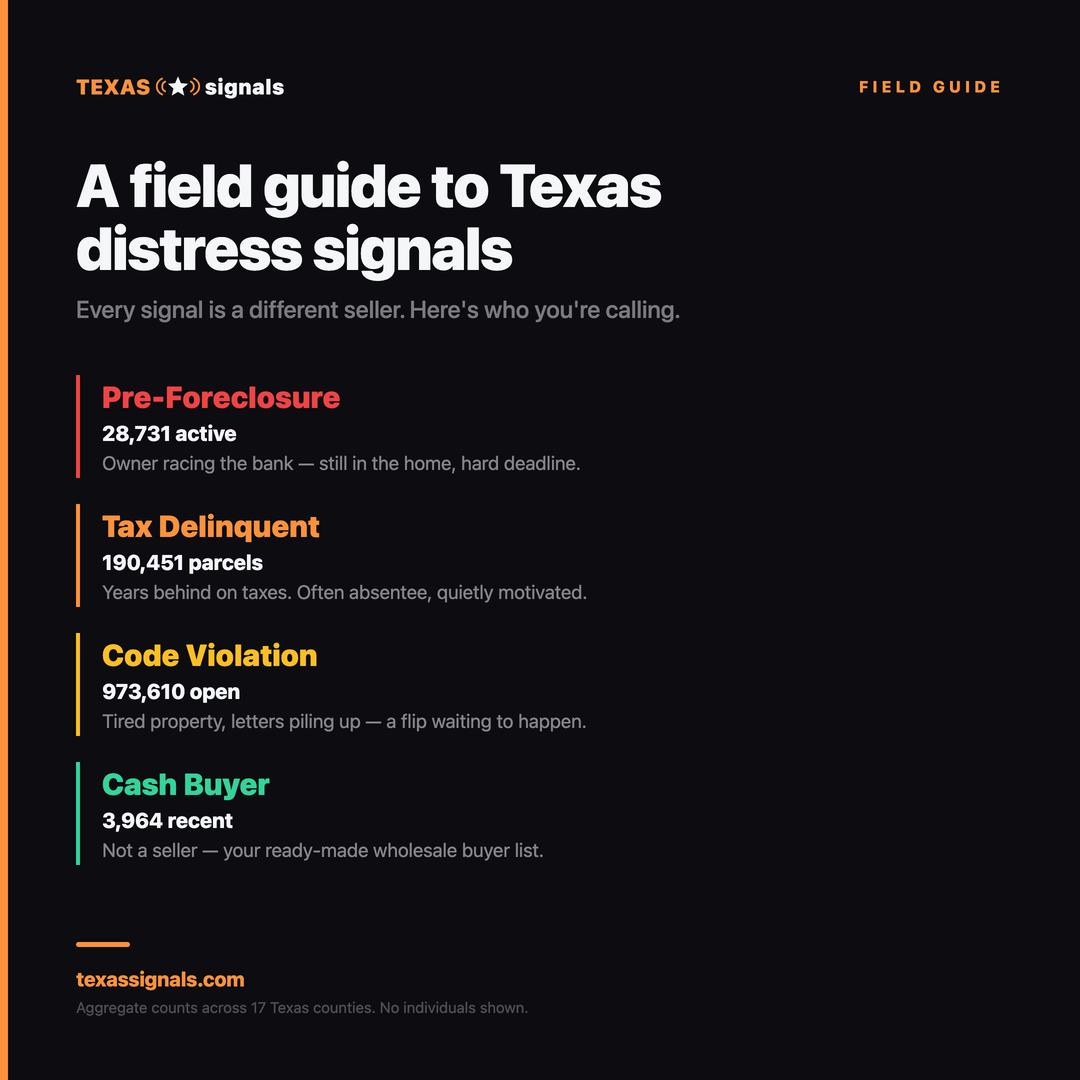
Source: Texas Signals — aggregate county data.
For a deeper explanation of how these signals feed the Intelligence Score, see The Texas Signals 1–100 Distress Score, Explained.
To access all 8 signals across 213 Texas counties, visit Texas Signals pricing.
See your county's data — start your 7-day free trial.