The Foundation of Every Lead
Every off-market deal in real estate starts the same way: someone's financial or personal situation changed, they couldn't manage a property anymore, and a record of that change was filed somewhere. That somewhere is a public records system.
Public records are the raw material of real estate investing. They don't care about market conditions, interest rates, or what the MLS says. They reflect the reality of what's happening with specific properties and owners right now — and they're available to anyone who knows where to look.
The problem for most investors isn't that public records are hard to access. The problem is that there are thousands of them, spread across 213 Texas counties, updated continuously, with no unified interface. That's the problem Texas Signals solves.
But understanding the underlying records — what they are, what they tell you, and how they become leads — makes you a better investor regardless of what tool you use to access them.
!How Public Records Become Investment Leads

Source: Texas Signals — aggregate county data.
The Main Public Record Systems in Texas
County Clerk Records
The county clerk is the central repository for real property records in Texas. Every county has one. Everything that happens to titled real property — sales, mortgages, liens, foreclosure notices, releases — is recorded with the county clerk and becomes a public record.
What you'll find:
•Deeds — warranty deeds, special warranty deeds, quitclaim deeds. Each transfer of ownership is a deed. From deeds you can determine who owns a property, who sold it, what entity it was transferred to, and (in most cases) the sale price.
•Deeds of Trust — the mortgage instrument in Texas. When someone borrows money to buy real estate, the lender records a deed of trust against the property. From deeds of trust you can see who the lender is, the loan amount, and the origination date.
•Notices of Default and Notices of Sale — the foreclosure filings. See How a Texas Foreclosure Actually Works for a full explanation of these filings and the timeline they create.
•Releases — when a loan is paid off, the lender records a release. A recent release on a property with a prior deed of trust indicates the owner paid off their mortgage — potentially indicating equity.
•Mechanic's and materialman's liens — filed by contractors who weren't paid for work. Indicates either a cash flow problem or a dispute.
•Tax liens — the county or municipality records a lien when property taxes go unpaid. Multiple tax liens on a property are a strong distress signal.
County clerk records in Texas are generally accessible via online portals. The quality, search capability, and recency of those portals varies significantly by county. Harris County (Houston) and Travis County (Austin) have sophisticated online systems. Many smaller Texas counties have paper-based or basic digital systems that require in-person access.
County Appraisal District (CAD) Records
Every Texas county has a Central Appraisal District that maintains the official record of property ownership for tax purposes. CAD records are separate from county clerk records — they track ownership, assessed value, property characteristics, and exemptions.
What you'll find:
•Owner name and mailing address — critical for outreach. The CAD mailing address is where tax notices are sent — often different from the property address for absentee owners.
•Assessed value — the county's determination of market value for tax purposes. Not always accurate, but a useful reference point.
•Property characteristics — square footage, year built, bed/bath count, lot size.
•Exemptions — homestead exemption indicates primary residence. No homestead exemption on a residential property is a strong indicator of investment or rental use.
•Ownership history — some CAD portals show historical owner records.
CAD records are updated annually with new appraisal data and on an ongoing basis as ownership transfers are recorded. They're publicly accessible via each county's CAD website.
Tax Assessor-Collector Records
Property tax delinquency information is maintained by the county tax assessor-collector (often the same office as the county clerk in smaller counties, separate in larger ones). Delinquent tax rolls are public records in Texas.
What you'll find:
•Properties with unpaid ad valorem taxes
•The amount owed, including penalties and interest
•The years of delinquency
•Sometimes, the delinquency status (lawsuit filed, payment plan, etc.)
Texas property taxes are paid in arrears and are due January 31 of the year following assessment. Taxes become delinquent February 1. The penalty structure is steep: 7% in February, adding 2% per month through July, for a total of 21% by mid-year. After July 1, the county adds a 20% collection fee if collection attorneys have been retained.
For more on how investors use tax delinquency data, see the Tax Delinquent Properties section in The 8 Distress Signals We Track Across Texas.
Justice of the Peace Court Records
JP courts in Texas handle eviction cases (forcible entry and detainer actions). JP court records are public and include the case plaintiff (landlord), defendant (tenant), property address, and case status.
What you'll find:
•Landlords who have filed for eviction — indicating tenant problems and possible landlord stress
•Property addresses associated with eviction activity
•Case outcomes — dismissed (tenant paid or landlord withdrew), judgment for plaintiff (landlord won), etc.
JP court records are particularly useful for identifying landlords who are struggling with their rental portfolios. A landlord with multiple evictions across multiple properties is a very different prospect than a first-time eviction case.
Secretary of State — Entity Formation Records
The Texas Secretary of State maintains records of all business entity formations, including LLCs, corporations, partnerships, and other structures. Formation records are public.
What you'll find:
•Entity name and formation date
•Registered agent name and address
•Principal office address
•Entity type (LLC, LP, corporation, etc.)
For real estate investors, SOS records are primarily useful for identifying new real estate entities — potential new buyers and competitors entering your market. We cross-reference SOS records against the Comptroller's Taxable Entity Search to verify active status and classify business type. For details, see How Texas Signals Verifies New LLCs with the Comptroller's Taxable Entity Search.
Municipal Code Enforcement Records
City and county code enforcement departments maintain records of violations issued against properties for conditions that violate local codes — structural disrepair, overgrown vegetation, junk vehicles, etc. Availability varies by jurisdiction.
What you'll find:
•Property address with open violations
•Violation type and description
•Date issued
•Current status (open, resolved, in compliance)
Code enforcement records are most useful as a secondary signal — properties with code violations are more likely to have disengaged owners, but violations alone rarely indicate immediate sale motivation.
How Public Records Become Actionable Leads
Raw public records are not leads. They're data. The process of converting them into leads involves several steps:
1. Aggregation. County records exist across 254 separate jurisdictions in Texas, each with its own systems, formats, and update schedules. Aggregating them into a unified feed requires crawling county portals, normalizing inconsistent data formats, and handling counties that publish records in non-standard ways.
2. Enrichment. A county clerk filing has a legal description of the property but may not have a street address. A tax record has an owner name but may have a PO box instead of a service address. Enrichment cross-references records against CAD data, USPS address databases, and other sources to produce complete, actionable records.
3. Classification. Not all distress signals are equal. Classifying signal types, weighting them by severity, and scoring properties based on signal stacking is what converts a list of records into a prioritized lead feed. See The Texas Signals 1–100 Distress Score, Explained for how our scoring works.
4. Delivery. Delivering enriched, scored records in a searchable, filterable interface — updated on a rolling basis — is the final step.
!Texas Signals — All 8 Signal Types
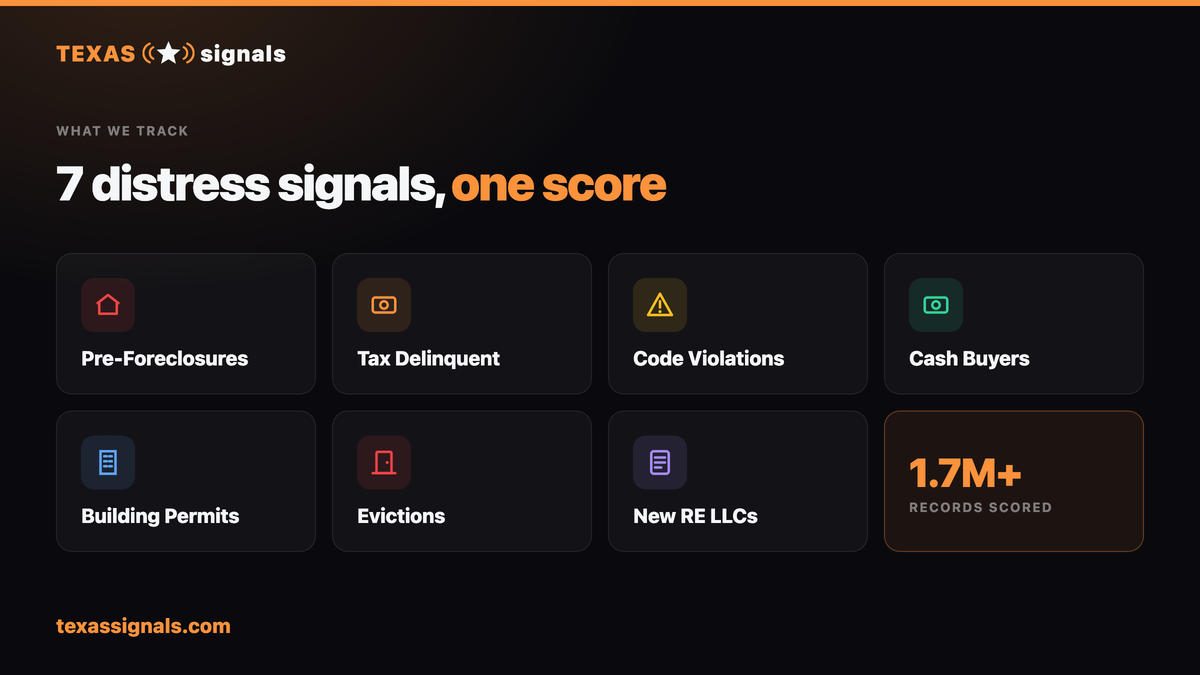
Source: Texas Signals — aggregate county data.
What You Can Do With This Yourself (And Where It Gets Hard)
For a single county, a determined investor can access most of these records manually. Pull the county clerk's grantor-grantee index. Download the CAD ownership file. Check the tax assessor's delinquency roll. It's time-consuming but not impossible.
At scale — multiple counties, multiple signal types, updated weekly — it becomes a full-time data operation. The engineering required to monitor filing systems across 213 counties, parse non-standard document formats, cross-reference multiple databases, and deliver clean records into a usable interface is what we've built at Texas Signals.
For investors working 1–3 counties deeply, the manual approach is viable. For anyone working multiple markets, or who needs speed on pre-foreclosure data where a week's lag matters, a purpose-built data platform is the practical choice.
To see how Texas Signals delivers these records across 213 counties, visit Texas Signals pricing.
See your county's data — start your 7-day free trial.