Let's Get Something Out of the Way
!Texas pre-foreclosure outreach — helping homeowners in distress find their path forward

Source: Texas Signals — aggregate county data.
You're here because you want to buy properties at a discount and make a profit. That's fine. That's the business. We're not going to pretend otherwise.
But here's what separates successful investors from the ones who burn out: the best deals come from genuinely helping people solve a problem they can't solve on their own.
A homeowner facing foreclosure doesn't need another vulture circling. They need someone who can explain their options clearly, make a fair offer, and close fast. When you do that right, both sides win — they walk away with cash and relief, you walk away with a deal and a clear conscience.
Every script below is built on three principles:
1.Lead with their situation, not yours. You're not calling to buy a house. You're calling because you noticed they might be dealing with something stressful, and you help people in that exact situation.
2.Give before you ask. Share useful information — even if they don't sell to you. Tell them about their options. If they can save their home, great. If they can't, you're the person they trust.
3.Be transparent about what you do. Don't hide behind vague language. You're an investor. You buy houses for cash. You make a profit. Honesty builds trust faster than any sales technique.
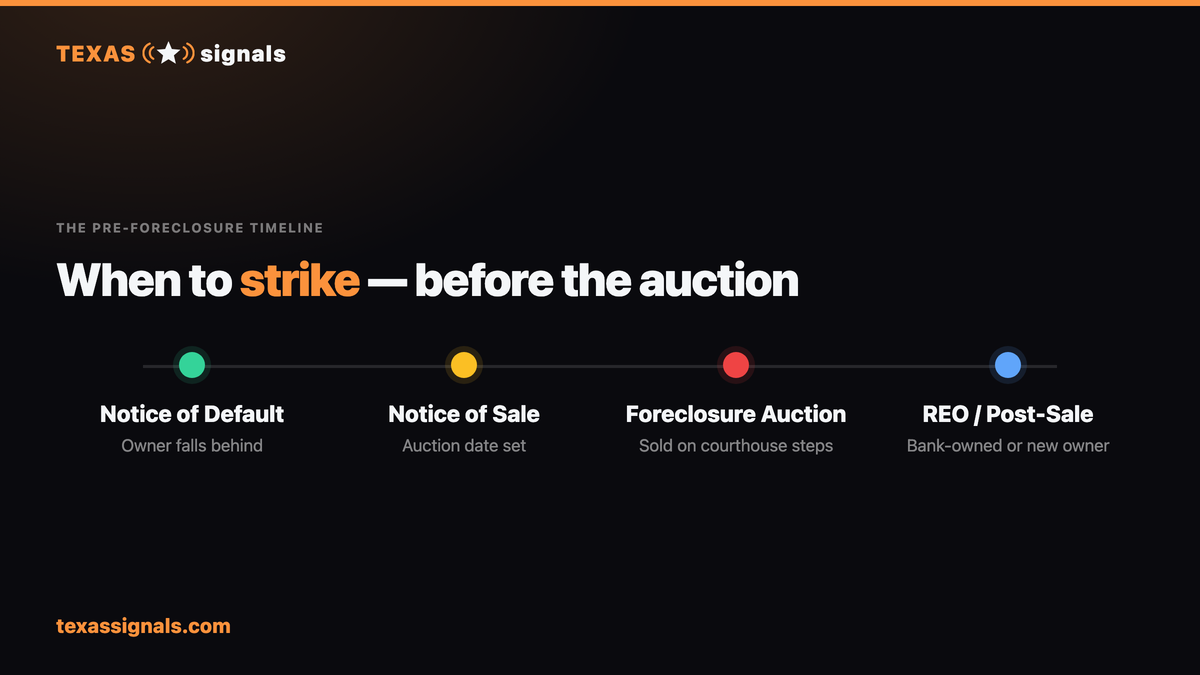
!Texas foreclosure timeline — from missed payment to auction day
Source: Texas Signals — aggregate county data.
Pre-Foreclosure Scripts (Lis Pendens / Notice of Default)
These homeowners know they're in trouble. They've received official notices from the lender. Many are scared, embarrassed, and avoiding phone calls. Your approach needs to be calm, non-judgmental, and informative.
Phone Script — Pre-Foreclosure
Ring ring...
"Hi, is this [Owner's First Name]? My name is [Your Name]. I'm a local real estate investor here in [City]. I'm reaching out because I came across a filing related to your property on [Street Name], and I wanted to see if you might be exploring your options."
If they're guarded or confused:
"I totally understand if this feels out of the blue. What I do is help homeowners who are dealing with a tough situation — whether that's falling behind on payments, facing a timeline from the lender, or just needing to sell quickly. I'm not a bank or a collection agency. I just want to make sure you know what choices you have."
If they're open to talking:
"Can I ask — what's your ideal outcome here? If you could wave a magic wand, would you rather keep the house or move on? There's no wrong answer. I just want to understand where you're at so I can figure out if I can help."
If they want to keep the house:
"That's great. Have you talked to your lender about a loan modification or forbearance? Those are usually the best first steps. I can walk you through how that process works if it would be helpful. And if that doesn't work out, I'm always here as a backup option."
If they want to sell:
"OK, let me ask you a few quick questions so I can put together a fair offer. There's no cost to you and no obligation — I'll just run the numbers and get back to you within 24 hours. Does that sound reasonable?"
Door Knock Script — Pre-Foreclosure
Door knocking pre-foreclosures is more effective than phone calls because it shows you're a real person, not a robocaller. But it requires more sensitivity because you're on their doorstep.
Knock knock...
"Hi [First Name], my name is [Your Name]. I live/work here in [City]. I stopped by because I noticed a county filing related to your property, and I work with homeowners in situations like yours."
Hand them a card or a simple one-page flyer.
"I'm not here to pressure you into anything. I just wanted to introduce myself in case you're looking at your options. I buy houses directly — no realtors, no commissions, no repairs needed. But I also know a lot about the foreclosure process, so if you just have questions, I'm happy to answer them."
If they're not interested:
"No problem at all. I'll leave my card in case anything changes. I genuinely hope things work out for you."
Direct Mail Script — Pre-Foreclosure
Subject line / outer envelope: "About your property on [Street Name]"
Letter:
Dear [First Name],
My name is [Your Name], and I'm a local real estate investor based in [City]. I'm writing because I came across a public filing related to your property at [Full Address].
I understand this might be a stressful time. I've worked with dozens of homeowners in similar situations, and I want you to know that you have more options than you might think.
Here's what I can offer:
- A fair cash offer within 24 hours of our conversation
- Closing on your timeline — as fast as 10 days or as slow as you need
- No repairs, no commissions, no fees
- Complete confidentiality
I'm not here to lowball you or pressure you. I run a straightforward business: I buy properties at a fair price, make improvements, and either sell or rent them. When the deal works for both of us, that's when I move forward.
If you'd like to explore your options, call or text me at [Phone]. No obligation, no pressure — just a conversation.
Respectfully,
[Your Name]
[Company Name]
[Phone]
Tax Delinquent Property Scripts
Tax-delinquent homeowners are in a different headspace than pre-foreclosure owners. They're usually not getting daily calls from a lender. The pressure is slower, more chronic. Many have been putting this off for years and feel stuck.
Phone Script — Tax Delinquent
"Hi [First Name], this is [Your Name]. I'm a real estate investor here in [City]. I'm reaching out because I was looking at public tax records and noticed your property on [Street Name] may have some outstanding tax obligations. I work with property owners in this kind of situation, and I wanted to see if you've been thinking about what to do with the property."
If they're defensive:
"I completely understand — you probably get calls about this. I'm not from the county and I'm not a tax collector. I'm just a local investor. What I've seen is that unpaid taxes can snowball with penalties, and sometimes the best option is to sell the property and walk away with cash rather than letting the county take it. But that's totally your call."
If they're open:
"Can I ask — are you currently living in the property, or is it something you're holding onto? And do you have a rough sense of how much is owed in back taxes?"
"Here's what I can do: I'll put together a cash offer that takes the back taxes into account. I'd handle paying those off at closing, and you'd walk away with the remaining equity in your pocket. No agent fees, no waiting for a buyer. Would you be open to hearing what that number looks like?"
Direct Mail Script — Tax Delinquent
Letter:
Dear [First Name],
I'm [Your Name], a local real estate investor. I'm writing about your property at [Address].
Public records show there may be outstanding property taxes on this property. I know that dealing with back taxes can feel overwhelming — especially with the penalties Texas adds every month. What started as a manageable amount can double in just a few years.
I want you to know there's a straightforward option: I can buy your property for cash, pay off the back taxes at closing, and put the remaining equity directly in your pocket. No repairs needed, no realtor commissions, and I can close as fast as you need.
I've helped other property owners in [City] get out of the same situation with zero stress. If you're interested in hearing what a fair offer looks like — or even if you just have questions about your options — give me a call at [Phone].
No pressure, no obligation.
[Your Name]
Code Violation Scripts
Properties with code violations often indicate an owner who has "checked out" — financially, emotionally, or both. Approach with curiosity, not judgment. Don't mention the violation directly unless they bring it up.
Phone Script — Code Violations
"Hi [First Name], this is [Your Name]. I'm a local real estate investor in [City]. I've been looking at properties in the [Neighborhood] area and came across yours on [Street Name]. I'm reaching out to see if you'd ever consider selling — I buy houses in any condition, and I take care of all the repairs myself."
If they seem open:
"I know sometimes properties can become a burden — whether it's maintenance, taxes, or just the hassle of dealing with it. I've bought quite a few properties where the owner just wanted to be done with the headache. No judgment at all — I've seen every situation imaginable."
"Would you be open to me taking a quick look at the property and putting together a cash offer? No cost to you, and absolutely no obligation."
Divorce Property Scripts
Divorce situations require extra sensitivity. Both parties may not agree on selling, and emotions run high. Your role is to be the neutral, practical option.
Phone Script — Divorce
"Hi [First Name], this is [Your Name]. I'm a local real estate investor, and I help people who need to sell a property quickly during a life transition. I understand you may be going through some changes, and I wanted to see if selling the property at [Street Name] is something you've been considering."
If they confirm they're divorcing:
"I'm sorry you're going through that. I've worked with several couples in similar situations where selling the house quickly for cash made the process a lot simpler — it takes the property out of the equation and lets both parties move forward. I can close fast, split the proceeds however your attorneys decide, and make the whole thing as painless as possible."
"Would both parties be open to hearing an offer? I'm happy to work with your attorneys to make sure everything is handled properly."
Eviction Filing Scripts
Eviction filings are a unique signal. The property owner isn't the one in distress — they're the one filing against a non-paying tenant. But that landlord is often deeply frustrated, burned out on property management, and more open to selling than you'd expect.
Why Eviction Filings Signal a Potential Seller
Think about what's happening: the landlord has a tenant who stopped paying rent. They've probably dealt with months of missed payments before filing. Now they're spending money on attorney fees and court costs, the property is generating zero income, and they're staring down a 30-60 day eviction process before they can even START finding a new tenant.
For many small landlords — especially accidental landlords who inherited a property or moved and decided to rent their old house — this is the last straw. They're done. They just want out.
Phone Script — Landlord with Eviction Filing
"Hi [First Name], my name is [Your Name]. I'm a local real estate investor in [City]. I noticed you have a rental property over on [Street Name], and I'm reaching out because I buy investment properties in that area. Have you ever thought about selling?"
If they bring up the tenant situation:
"Yeah, bad tenants are honestly the worst part of owning rental property. I've been there myself. The eviction process in Texas takes forever, and even after they're out, there's usually cleanup and repairs before you can re-rent it. It's exhausting."
"Here's what a lot of landlords in your situation do: they sell the property to someone like me who handles the eviction, the cleanup, and the re-tenanting. You walk away with cash and no more headaches. I can even close while the tenant is still in the property — that's not a problem for me."
If they're thinking about it:
"I know selling a rental feels like giving up an income stream. But let me ask you this — after the eviction costs, the vacancy, the repairs, and the re-leasing fees, what's your actual return on this property over the last two years? A lot of times when landlords run those numbers honestly, selling and reinvesting that capital somewhere less stressful makes a lot more sense."
Direct Mail Script — Landlord with Eviction Filing
Dear [First Name],
I'm [Your Name], a real estate investor based in [City]. I'm writing about your property at [Address].
I know that managing rental properties can be incredibly rewarding — until it isn't. If you've reached a point where this property feels more like a burden than an asset, I'd like to offer a straightforward exit.
I buy rental properties for cash, in any condition, with or without tenants in place. You don't need to handle repairs, evictions, or cleanup. I take care of all of that.
If you're curious what your property is worth as a cash sale, give me a call at [Phone]. No agents, no commissions, no obligations. Just a real number from a real buyer.
[Your Name]
Absentee Owner Scripts
Absentee owners — people who own a property but live somewhere else — are often the easiest conversations. They're not emotionally attached to the property the way a homeowner is.
Phone Script — Absentee Owner
"Hi [First Name], my name is [Your Name]. I'm a real estate investor here in [City]. I noticed you own a property at [Address] but it looks like you may not be living there currently. I'm looking to buy properties in that area — would you ever consider selling?"
If they're a landlord:
"How's the rental going? Are you getting good returns, or has it been more of a headache than it's worth? I ask because a lot of landlords I talk to have reached a point where they'd rather take the cash and invest it somewhere with less hassle."
If it's an inherited property:
"I understand. Inherited properties can be complicated — dealing with the estate, figuring out repairs, coordinating with family members. A lot of people in that situation find it's easier to sell for cash and split the proceeds. I can handle all the cleanup and repairs — you don't have to do anything."
The Follow-Up Framework
Most deals don't close on the first call. Here's a follow-up cadence that's persistent without being annoying:
Week 1: Initial outreach (call, text, or mail)
Week 2: Follow-up call or text — "Hey [Name], just checking in. No pressure, just wanted to see if you've had a chance to think about our conversation."
Week 4: Second follow-up — share a piece of useful information. "I put together a quick market analysis of your area. Properties like yours are selling for [range]. Happy to share it if you're curious."
Week 8: Gentle check-in — "Hi [Name], just wanted to see if anything has changed on your end. I'm still interested in your property whenever you're ready."
Month 3+: Quarterly touch base — keep it brief and low-pressure.
What NOT to Do
Let's be blunt about the approaches that give investors a bad name:
1."I know you're about to lose your house..." — Never lead with fear. It's manipulative and often inaccurate (many foreclosures get resolved).
2."I can ONLY pay $X..." — Fake urgency and artificial scarcity. Make a fair offer. If it doesn't work, negotiate. Don't play games.
3.Mass robocalls or spam texts — Illegal without consent (TCPA), annoying, and ineffective. One personal call is worth 100 robocalls.
4.Pretending to be from the government or the bank — Obvious, but it happens. This is fraud. Don't.
5.Pressuring someone to sign on the spot — Always give people time to think, consult an attorney, or talk to family. A deal that closes under pressure is a deal that unwinds later.
6.Lowballing to the point of exploitation — Yes, you need margin. No, you don't need to offer 30 cents on the dollar to someone who's desperate. Fair offers build a reputation that generates referral deals for years.
The Bottom Line
The scripts above are starting points — adapt them to your personality and your market. The exact words matter less than the energy behind them. If you genuinely care about helping the person on the other end of the phone, that comes through. If you're just trying to extract a cheap deal, that comes through too.
The best investors we've seen using Texas Signals data aren't the hardest closers. They're the ones who show up first (because they have the data), listen carefully (because they're not desperate), and make fair offers (because they've done the math). That combination — speed, empathy, and preparation — is what turns distress signals into deals that work for everyone.
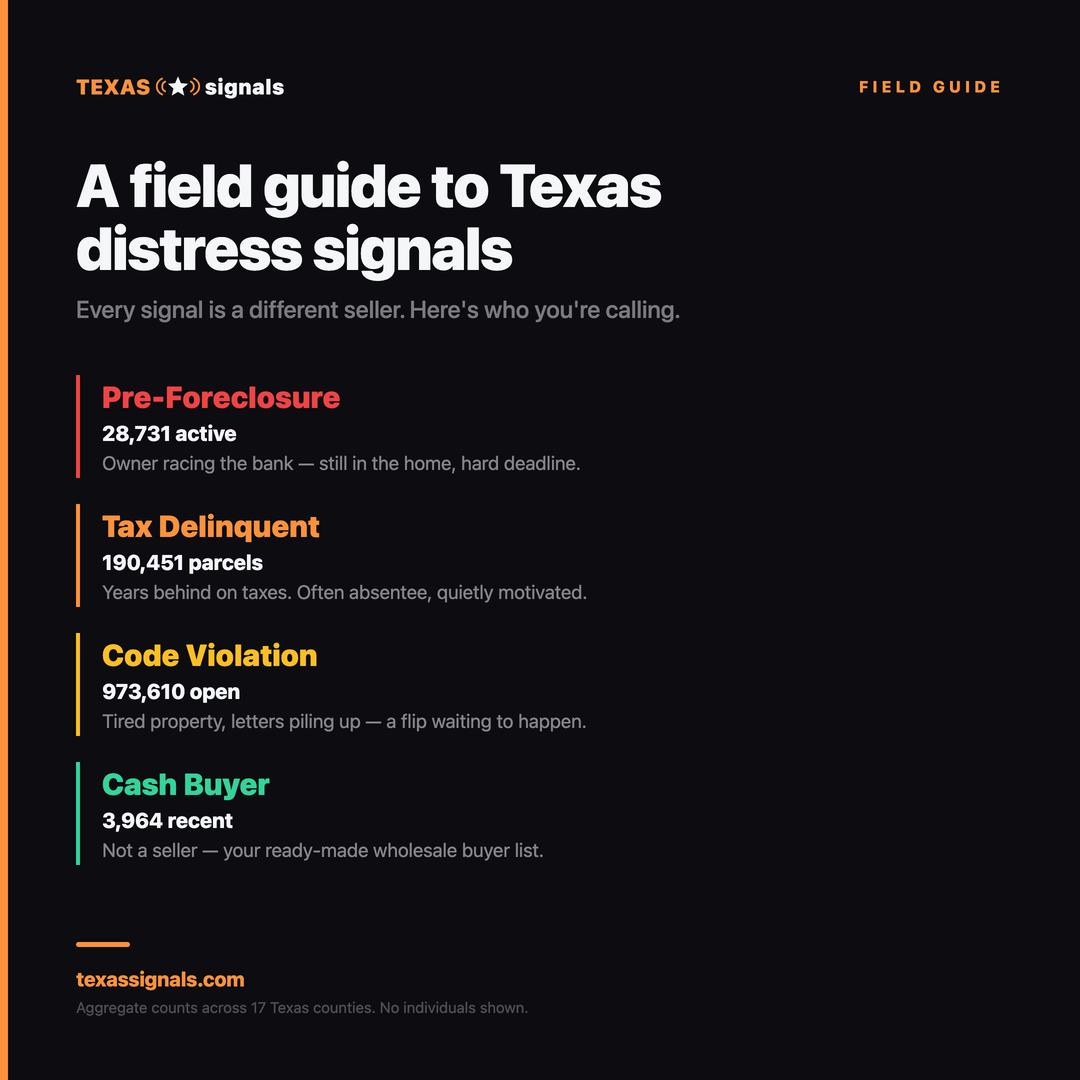
!Texas Signals outreach field guide — scripts for every distress signal type
Source: Texas Signals — aggregate county data.