The Old Way vs. the Data Way
!Texas off-market deals — using public records to find motivated sellers without cold calling

Source: Texas Signals — aggregate county data.
The traditional approach to finding off-market deals goes something like this: drive for dollars, scribble down addresses of run-down houses, go home, skip trace the owners, and start cold calling. Repeat until you hate your life or close a deal — whichever comes first.
There's nothing wrong with hustle. But there's a smarter starting point: public records data.
<!-- coverage-ok: a true fact about Texas counties, not a claim about our coverage -->
Every county in Texas maintains public databases of property transactions, court filings, tax records, building permits, code enforcement actions, and business entity registrations. Individually, these records tell you isolated facts. Combined, they tell you a story — and that story is often "this property owner is motivated to sell."
The Five Public Record Signals
Think of each signal as a layer. One layer is interesting. Two layers stacked together is a lead. Three or more? That's a deal you need to move on.
Signal 1: Pre-Foreclosure Filings
What it tells you: The homeowner has stopped paying their mortgage. The lender has filed a Notice of Default or lis pendens.
Why it matters: This is the most direct "motivated seller" signal. The homeowner is literally facing the loss of their property.
The catch: Everyone knows about pre-foreclosures. The competition is highest here. You need speed and a good approach.
How to use it: Don't just pull the list and cold call. Look at the filing date and auction date. Fresh filings (last 30 days) give you more time. Sort by equity — high-equity pre-foreclosures are the ones worth pursuing.
Signal 2: Tax Delinquency
What it tells you: The homeowner has stopped paying property taxes. This might mean cash flow problems, absentee ownership, or a decision to walk away.
Why it matters: Tax delinquency is a slower, quieter signal than foreclosure. Many of these property owners have been struggling for years and would welcome a way out.
The catch: Some tax delinquent owners are simply behind a few months and will catch up. Focus on 2+ years delinquent for higher motivation.
How to use it: Cross-reference with property value data. A homeowner who's $8,000 behind on taxes on a $300,000 property has plenty of equity and strong motivation to resolve the issue.
Signal 3: Code Violations
What it tells you: The city has cited the property for maintenance, safety, or zoning violations. Overgrown lots, structural damage, unpermitted work, or abandoned vehicles.
Why it matters: Code violations often signal deferred maintenance, which signals financial distress or absentee ownership. Multiple open violations on a single property is a strong indicator.
The catch: Some violations are minor (trash on the curb) and don't indicate distress. Focus on structural violations, repeat offenders, and properties with multiple open cases.
How to use it: A property with open code violations AND tax delinquency is a much stronger lead than either signal alone.
Signal 4: Cash Buyer Activity
What it tells you: All-cash transactions in a ZIP code reveal who is actively investing in your market and what they're paying.
Why it matters: Cash buyers are your potential buyer list for wholesale deals. They're also market indicators — heavy cash buying activity signals neighborhood-level investment interest.
How to use it: Build a list of repeat cash buyers in your target ZIP codes. When you find a deal, these are the first people you call. They can close fast and don't need bank approval.
Signal 5: New LLC Filings
What it tells you: Someone just formed a real estate LLC in Texas. They're gearing up to invest.
Why it matters: New LLCs with registered agents in your market are either: (a) new investors who need deal flow, or (b) experienced investors expanding their portfolio. Both are potential buyers or JV partners.
How to use it: Filter by entity type (investor, wholesaler, developer) and formation date. Reach out to newly formed LLCs — they're actively looking for opportunities.
!Texas Signals — 8 distress and opportunity signal types tracked across all Texas counties
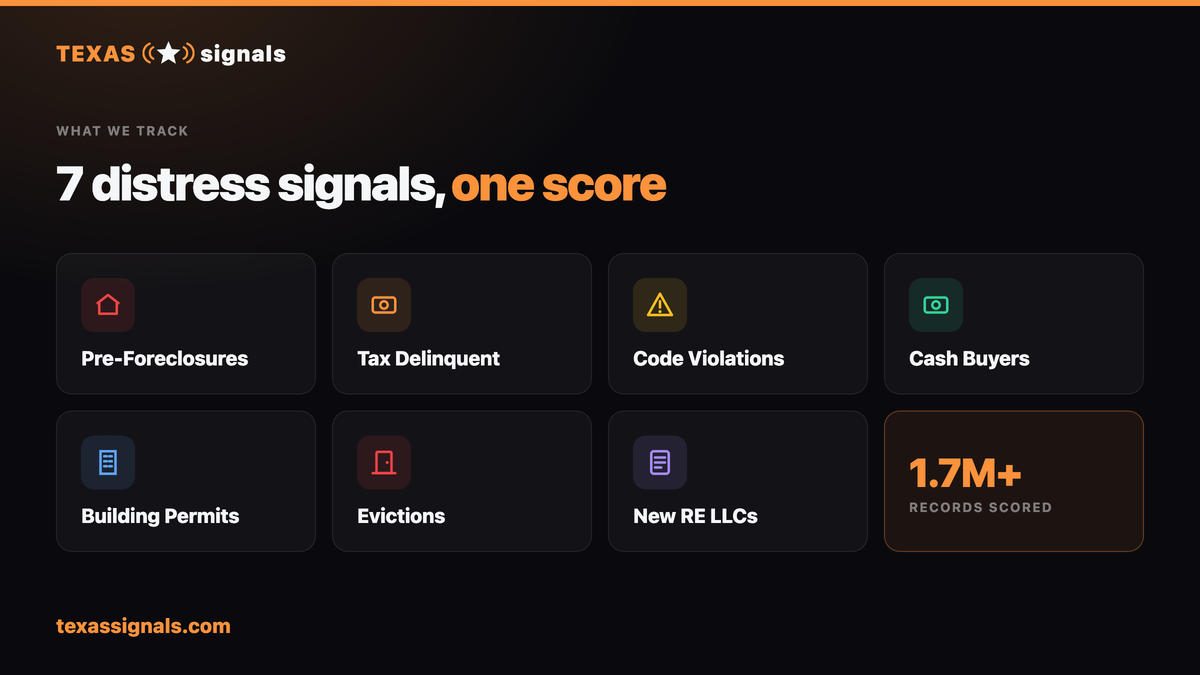
Source: Texas Signals — aggregate county data.
Stacking Signals: The Intelligence Score Approach
Here's where the magic happens. Instead of working each signal type independently, you stack them.
Texas Signals' Intelligence Score does exactly this. It looks at a property and asks:
•Does this property have a pre-foreclosure filing? (+25 points)
•Is it tax delinquent? (+15 points)
•Are there open code violations? (+10 points)
•Is the auction date within 60 days? (+10 points)
•Is there positive equity? (+10 points)
•Is the owner absentee (mailing address differs from property)? (+5 points)
•Multiple years of tax delinquency? (+5 points)
•Recent price decline in the CAD assessment? (+5 points)
A property with a score of 75+ has multiple overlapping distress signals. That's not just a lead — it's a high-probability deal.
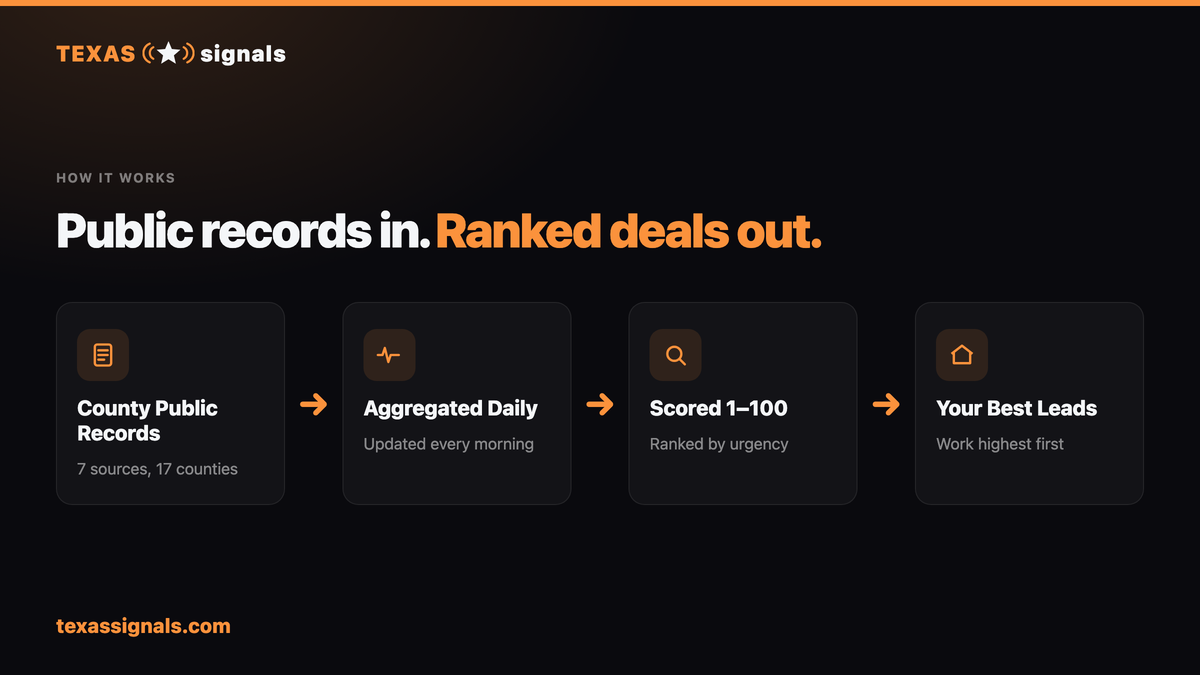
Source: Texas Signals — aggregate county data.
The Skip Tracing Step (Without Cold Calling)
"But wait," you say. "You promised no cold calling." Here's how:
Direct Mail
Use the property address and owner name from public records to send a personalized letter. Not a mass-mailed postcard — a real letter that mentions their specific situation.
"I noticed your property at 123 Oak Street has some outstanding tax obligations. I help property owners in your situation find straightforward solutions. If you've been thinking about selling, I'd like to make a fair cash offer with no fees or commissions."
Door-to-Door (Warm, Not Cold)
You're not knocking random doors. You're visiting a specific property where the data tells you the owner is likely motivated. That's a warm approach, not a cold one.
Digital Outreach
If you can find the owner's email through skip tracing, a well-crafted email can be effective. Keep it short, specific, and lead with their situation.
Text (With Consent)
Some investors use text messaging. Be careful here — you need to comply with TCPA regulations. But a respectful text to a verified property owner about their specific situation can get responses.
Building Your Deal Pipeline
Here's the system that works:
Step 1: Set Your Filters
Pick your target city and ZIP codes. Set your minimum lot size if you're looking for development deals. Filter for 2+ years tax delinquent or pre-foreclosures with 60+ days to auction.
Step 2: Export and Score
Export your filtered list. If you're using Texas Signals, the Intelligence Score is already calculated. Sort by score, descending.
Step 3: Skip Trace the Top 50
You don't need to skip trace 500 leads. Start with 50. Use a service like PropertyRadar, BatchSkipTracing, or REISkip. Cost: roughly $0.10-$0.15 per record.
Step 4: Multi-Channel Outreach
Send a letter, follow up with a text (if you have consent), and consider a door knock for the highest-scoring properties. Don't rely on a single channel.
Step 5: Follow Up
Most deals don't close on the first contact. The fortune is in the follow-up. Set a 30-day, 60-day, and 90-day follow-up cadence for every lead that doesn't immediately say "no."
Step 6: Run Numbers and Make Offers
For every conversation that gets to the offer stage, run your numbers thoroughly: ARV, repair costs, holding costs, closing costs, and your desired profit. Make fair offers and be prepared to walk away.
The Competitive Advantage of Speed
Public records are public. Anyone can access them. So where's the competitive advantage?
Speed. County clerks process filings in batches. Some update daily, some weekly, some monthly. The investor who sees a fresh pre-foreclosure filing on Day 1 has a massive advantage over the investor who sees it on Day 30.
Texas Signals scrapes county records daily across 209 counties. When a new lis pendens is filed in Travis County on Tuesday morning, it's in your dashboard by Tuesday evening. That speed — combined with signal stacking and Intelligence Scoring — is how you find deals before the competition.
Common Mistakes
1.Analysis paralysis — Don't wait for the perfect lead. Your first 50 outreach attempts will teach you more than 50 hours of research.
2.Ignoring follow-up — 80% of deals close after the 3rd+ contact. Most investors give up after 1.
3.Single-signal thinking — A list of pre-foreclosures alone isn't special. Stacking signals is what separates data-driven investors from list-pullers.
4.Lowball offers — Making offers at 40 cents on the dollar doesn't work in 2026. Motivated sellers still know what their property is worth. Fair offers close; insultingly low ones get you blocked.
5.Not knowing your market — ARV, rent rates, days on market, renovation costs per square foot. Know these numbers for your target ZIP codes before you make your first call.
Bottom Line
Off-market deals aren't hidden. They're sitting in public records, waiting for someone to connect the dots. The investors who build systems around data — filtering, scoring, and stacking signals — find more deals with less effort than the ones grinding through cold call lists.
Start with the data. Let the signals guide your outreach. And remember: behind every data point is a real person going through a difficult time. Lead with respect and genuine problem-solving, and the deals will follow.