The Recycled Data Problem
Most national real estate data tools work the same way. A handful of data aggregators — ATTOM, CoreLogic, BatchLeads, and a few others — compile county records from across the country, normalize them into a standard schema, and license that data to downstream platforms. Those platforms then build a UI on top and sell subscriptions.
The problem isn't the data itself. It's the pipeline.
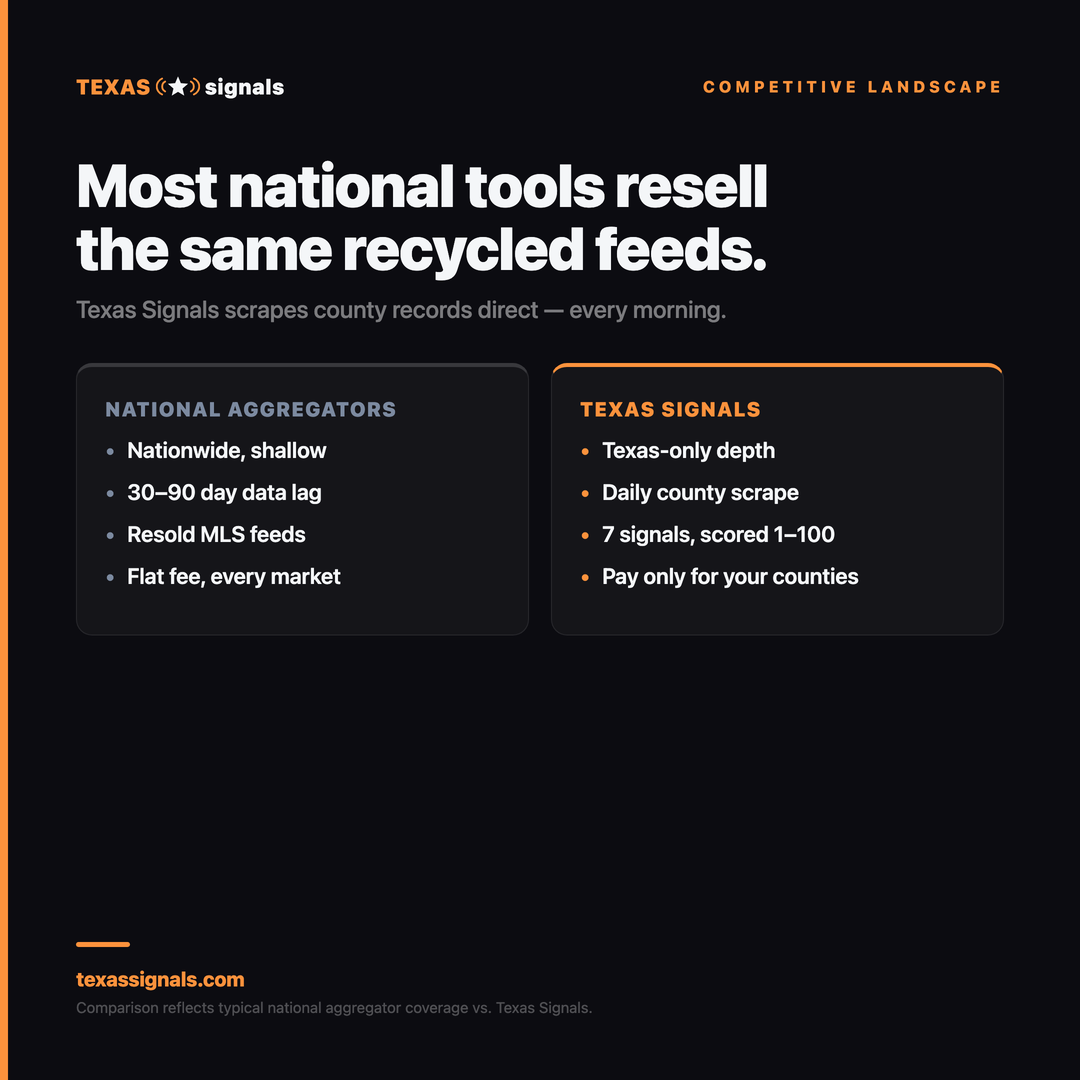
By the time a county record flows from the county clerk's system, through an aggregator's normalization process, through a downstream platform's database, and into your dashboard, 30 to 90 days have passed. For some record types and some counties, it's longer.
In a market that moves as fast as Texas real estate, that lag is significant. The investor who finds a pre-foreclosure filing 10 days after it's recorded and reaches out gets a fundamentally different conversation than the one who finds it 60 days later — when the homeowner has already been contacted by six other investors, listed with an agent, or resolved the filing.
Where National Tools Specifically Fail on Texas New Investors
National platforms have a particular blind spot for new market entrants. Their cash buyer databases are built from deed records — transactions that have already closed. By definition, a buyer who has never closed a deal in Texas is invisible to those lists.
New real estate LLCs formed in Texas — the signal that identifies buyers before their first acquisition — require state-specific infrastructure to capture correctly:
•Real-time monitoring of the Texas Secretary of State formation filings
•Cross-referencing against the Texas Comptroller's Taxable Entity Search for franchise tax status and business classification
•A Texas-specific classification model to distinguish real estate entities from the thousands of other LLCs formed in Texas each month
No national aggregator does this for Texas specifically. It's not economically rational for a platform serving 50 states to build and maintain state-specific entity verification pipelines for each one. They scrape what's available in bulk and move on.
!Texas Signals vs. National Aggregators
Source: Texas Signals — aggregate county data.
The County-Direct Advantage
Texas Signals sources data directly from county records — not from a national aggregator's normalized feed. That means:
Faster access. We see filings as they appear in county systems, not after they've gone through a multi-week aggregator pipeline. Our pre-foreclosure, tax delinquent, and LLC formation signals are measured in days from recording, not months.
Texas-specific enrichment. We know the quirks of individual county recording systems. DCAD in Dallas has different data completeness characteristics than HCAD in Houston, which is different from Bexar County's system. We've built county-specific parsers and enrichment logic rather than forcing Texas counties into a generic national schema.
213-county coverage. Texas has more counties than any state except Georgia. Many national platforms have inconsistent coverage in rural Texas counties — the data exists, but the aggregator hasn't prioritized those counties for their national pipeline. We cover 213 counties and counting.
New LLC signal. As described above, national tools simply don't have this. It requires Texas-specific infrastructure that isn't economically justified for a national platform.
What the Lag Actually Costs You
Let's make this concrete. Assume you're working pre-foreclosure leads in the DFW market.
With a 60-day lag, you receive leads where the Notice of Default was filed roughly two months ago. In that time:
•The homeowner has likely been contacted by every other investor in the market running the same lagged feed
•Some percentage have already listed with an agent
•Some have resolved the delinquency through reinstatement or loan modification
•Some have already been foreclosed — the sale happened before you even knew the lead existed
With a 7-day lag, you receive leads where the notice was filed about a week ago. The homeowner may not have received any investor outreach yet. You have time to research the property, make a thoughtful approach, and start a real conversation before the market saturates.
That delta — 7 days versus 60 days — is worth far more than any difference in subscription price between platforms.
!New LLC Edge — Speed Is the Advantage

Source: Texas Signals — aggregate county data.
The 8 Signal Types National Tools Handle Inconsistently
Texas Signals tracks 7 distinct distress and opportunity signals across 213 Texas counties:
1.Pre-foreclosures — Notices of Default and Notices of Sale filed at the county level
2.Tax delinquent properties — properties with outstanding ad valorem tax obligations
3.Code violations — municipal code enforcement actions (available in covered municipalities)
4.Cash buyer transactions — arms-length cash deed transfers with buyer entity identification
5.Permit activity — building permit applications and approvals as a renovation and investor activity signal
6.Eviction filings — JP court filings indicating landlord stress or tenant default
7.New real estate LLCs — verified new entity formations classified as real estate operations
National platforms have reasonable coverage of pre-foreclosures and cash buyers in major Texas metros. Their coverage of tax delinquencies, code violations, evictions, and new LLCs is inconsistent — and in many Texas counties, effectively nonexistent.
For a full breakdown of all eight signals, see The 8 Distress Signals We Track Across Texas.
To compare data access options, visit Texas Signals pricing.
See your county's data — start your 7-day free trial.