Why a Score, Not Just a List
Texas has 1.8M+ records in our database spanning 213 counties and 8 signal types. Presenting that as a raw list — sorted by county and record type — would be technically complete and practically unusable.
The Intelligence Score exists to answer one question: given limited time and outreach capacity, which properties should you work first?
A property with a single tax delinquency from three years ago and no other signals is a cold lead. A property with a Notice of Default filed last week, two years of unpaid taxes, and an open code violation is a hot lead. The score quantifies that difference so you can prioritize without manually reviewing every record.
!Texas Signals Distress Score Gauge
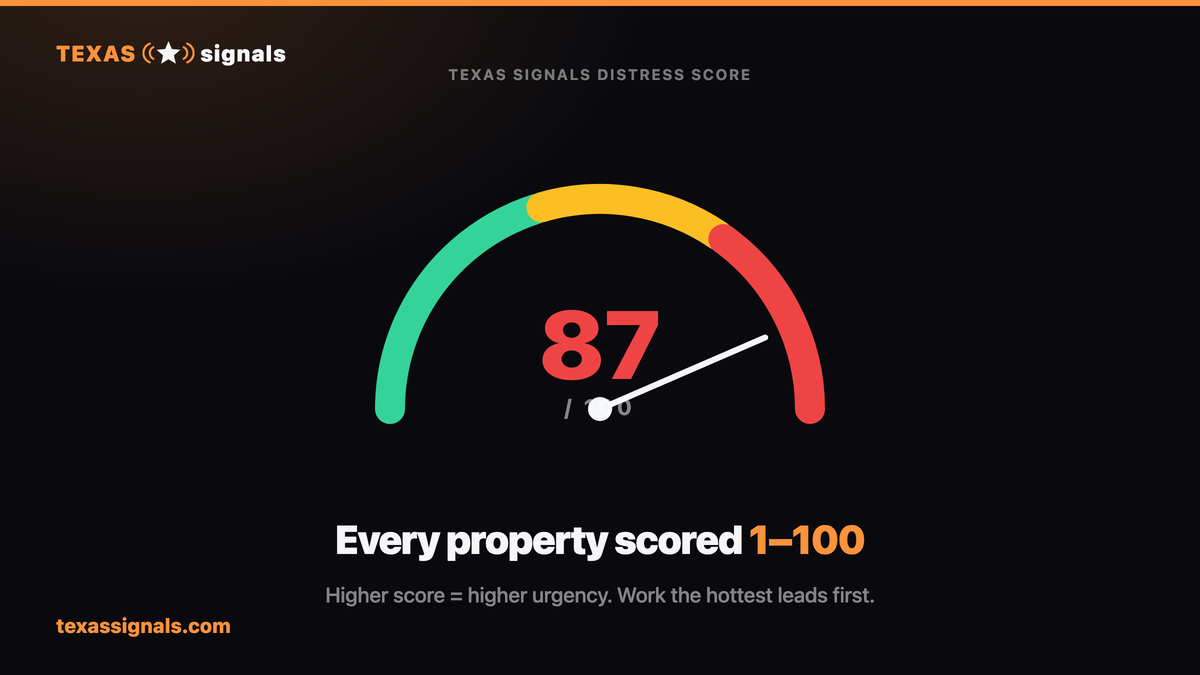
Source: Texas Signals — aggregate county data.
What Goes Into the Score
The Intelligence Score is a weighted composite of four dimensions: signal count, signal type weight, recency, and severity.
Signal Count
A property that triggers multiple signal types scores higher than one with a single signal. Each additional verified signal type adds to the base score. The relationship is not simply additive — there are diminishing returns past the third or fourth signal, because at that point the property is already clearly high-distress regardless of further stacking.
Signal stacking example:
•Tax delinquent only: moderate base score
•Tax delinquent + pre-foreclosure: significant score increase
•Tax delinquent + pre-foreclosure + code violation: high score, near or at prioritized threshold
Signal Type Weight
Not all signals carry equal weight. We assign type weights based on actionability — how directly the signal indicates an owner who is likely to consider a sale.
Highest weight signals:
•Pre-foreclosure (Notice of Default, Notice of Sale) — direct timeline pressure, owner has limited options
•Tax delinquent with penalty accumulation — financial pressure compounding over time
Medium weight signals:
•Code violations — indicates owner disengagement or inability to maintain
•Eviction filings — landlord stress, potential motivation to exit
Lower weight signals (valuable in combination):
•Permit activity — indicates investment in property, may indicate flip candidate or active operator
•New LLC nearby activity — contextual market signal, not direct property-level distress
Recency
A pre-foreclosure filed last week is a fundamentally different signal than one filed 18 months ago. Older signals decay in weight over time, with the decay rate calibrated to the signal type.
•Pre-foreclosure signals decay quickly — a notice that's 90+ days old without resolution has either been foreclosed or reinstated. We weight recent notices heavily and reduce weight on aged ones.
•Tax delinquency signals decay more slowly — a property that has been delinquent for two years is still a motivated lead. The recency adjustment here is more gradual.
•Code violations have a medium decay rate — active violations are scored higher than resolved or aged ones.
Severity
Where data allows, severity factors into the score. For tax delinquencies, severity is measured by the delinquency amount relative to assessed value — a property with $40,000 in back taxes on a $120,000 assessed value is scored differently than one with $2,000 in delinquency on the same value. For pre-foreclosures, a Notice of Sale (imminent foreclosure) is scored higher than a Notice of Default (early stage).

Source: Texas Signals — aggregate county data.
Score Ranges and What They Mean
70–100: High Priority. These properties have multiple recent, high-weight signals with significant severity. Owner motivation to sell is likely. Prioritize these for immediate outreach.
40–69: Medium Priority. Meaningful distress signals present, but either fewer signals, lower individual weight, or older recency. Worth working after high-priority leads are contacted.
10–39: Low Priority / Monitor. Single signals, low severity, or aged records. These may be worth watching for escalation — if a low-priority property gains a new signal, the score will update accordingly.
1–9: Informational. Minimal distress signals. May be useful for contextual research but unlikely to indicate an actively motivated seller.
What the Score Does Not Measure
The Intelligence Score is a distress and actionability signal. It is not:
•An AVM or price estimate. The score says nothing about what the property is worth. Use it alongside your own comparable analysis.
•A motivation guarantee. High-distress properties have motivated owners more often than not — but not always. Some owners are in distress and still unwilling to sell below retail. The score improves your batting average, it doesn't guarantee a hit.
•A title or lien analysis. The score reflects signal data from public records. It does not incorporate a full title search, lien prioritization analysis, or encumbrance review. Always do your diligence.
How the Score Updates
Scores are not static. When new signals are added to a property — a new tax filing, an escalated code violation, a Notice of Sale following an earlier Notice of Default — the score recalculates. Properties that were medium-priority can move into high-priority as their situation changes.
We recommend checking your target county's top-scored properties at least weekly. A property that scored a 45 last month may score a 78 today because a foreclosure notice just landed.
For more on the 8 signal types that feed the score, see The 8 Distress Signals We Track Across Texas.
To see data access options, visit Texas Signals pricing.
See your county's data — start your 7-day free trial.