Two Databases, One Verified Signal
When a new real estate LLC appears in Texas, it goes through the Secretary of State first. That filing creates a public record: the entity name, registered agent, formation date, and principal address. That's the data most platforms scrape and call it done.
We don't stop there.
Every entity flagged as a potential real estate LLC in our pipeline gets cross-referenced against the Texas Comptroller's Taxable Entity Search — a separate, independently maintained database that tracks franchise tax status, business activity classification, and taxpayer registration. The two databases don't always agree, and the gaps between them are exactly where the signal lives.
!New LLC Verification Pipeline
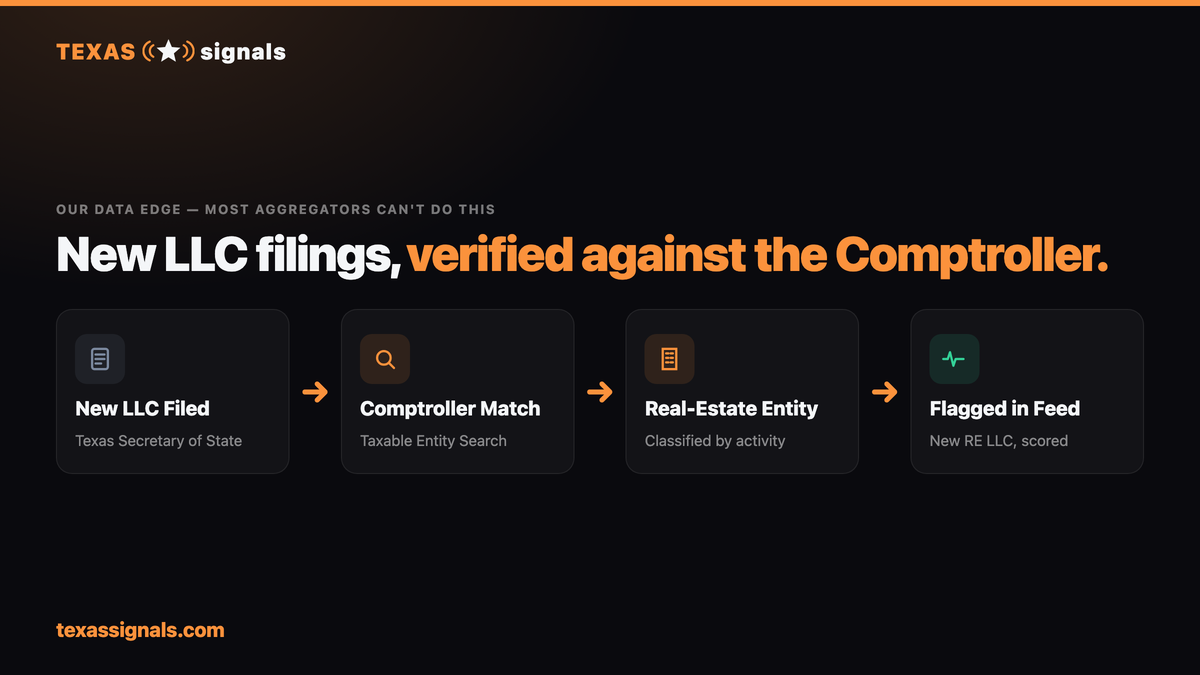
Source: Texas Signals — aggregate county data.
Why the SOS Filing Isn't Enough
The Secretary of State records a filing the moment it's submitted and accepted. That tells you the entity exists on paper. It doesn't tell you:
•Whether the entity is in good standing for franchise tax purposes
•Whether it has been voluntarily dissolved or forfeited by the Comptroller for nonpayment
•Whether the business activity is classified as real estate versus construction, management, holding company, or something else entirely
•Whether the registered address is a real operating office or a registered agent's forwarding address
For investors using LLC formation as a signal for new market entrants, a stale or dissolved entity is noise — it will send you chasing a company that no longer exists in any meaningful sense.
The Cross-Check Process
Our pipeline works in three steps.
Step 1 — SOS Scrape. We pull new entity formations filed with the Texas Secretary of State on a rolling basis, across 213 counties. Each filing is parsed for entity name, formation date, registered agent, and principal address.
Step 2 — Comptroller Cross-Reference. Every entity is submitted against the Taxable Entity Search API. We record franchise tax status (active, forfeited, voluntary dissolution), the taxpayer's SIC/NAICS classification, and the date of last status change.
Step 3 — Real Estate Classification. Entities with classifications in real estate acquisition, property holding, property management, residential construction, or related categories are flagged and routed into the New LLC signal feed. Entities that are forfeited, dissolved, or classified outside real estate are filtered out or flagged with a low confidence score.
What the Verified Feed Tells You
Once an entity clears both checks, it surfaces in your Texas Signals dashboard with:
•Entity name and formation date from SOS
•Franchise tax status from the Comptroller (active / good standing)
•Business classification — real estate acquisition, property management, holding company, etc.
•Registered address and principal place of business
•Signal confidence score — weighted by recency, classification match, and address quality
!New LLC Edge — What You See Others Miss

Source: Texas Signals — aggregate county data.
Three Ways Investors Use This Signal
Spotting New Competitors Before Their First Close. A new real estate LLC in your target county almost certainly means a new buyer in the market. You'll see them in the New LLC feed weeks or months before they show up on cash buyer lists — because cash buyer lists are built from deed records, and deeds don't appear until after closing.
Identifying JV Partner Candidates. Not every new LLC is a competitor. Many are first-time investors who formed an entity to start wholesaling or fix-and-flip. The formation date, address, and entity name often telegraph experience level and strategy. An entity named "Oak Creek Acquisitions LLC" formed six months ago in a smaller Texas market is a very different conversation than a national fund's new Texas subsidiary.
Finding Fresh Cash Buyers. Cash buyers who bought in other markets and are now expanding into Texas will form a new entity before their first acquisition. Our New LLC feed catches that formation event. Combined with our cash buyer transaction database, you can see when an existing buyer from outside Texas enters your market — before they've closed a single deal here.
Why National Aggregators Can't Do This
National data platforms scrape county records at scale. They're optimized for breadth, not depth. Running a real-time cross-check against a state-specific database like the Texas Comptroller's Taxable Entity Search requires state-specific infrastructure, a Texas-specific entity classification model, and ongoing maintenance as the Comptroller's data formats change.
That's not a problem national platforms are going to solve for Texas specifically. It's a Texas-native advantage — and it's one of the reasons we built Texas Signals as a Texas-first product rather than a national platform with a Texas tab.
For more on how we source data differently from national tools, see Why National Data Tools Miss the Newest Texas Investors.
See your county's data — start your 7-day free trial.