What Is Wholesaling?
Source: Texas Signals — aggregate county data.
Wholesaling is the practice of putting a property under contract and then assigning that contract to an end buyer for a fee. The wholesaler never takes title to the property. Instead, they act as a matchmaker between motivated sellers and cash buyers, earning an assignment fee (typically $5,000-$25,000) for identifying and securing the deal.
Is Wholesaling Legal in Texas?
Yes. Texas Property Code Section 5.086 explicitly addresses the assignment of real property contracts. However, there are important guardrails:
1.Disclosure — You must disclose to the seller that you intend to assign the contract
2.Equitable interest — Your contract must create a legitimate equitable interest in the property
3.Marketing — You are marketing your equitable interest in the contract, not the property itself
4.Licensing — As of 2024, Texas does not require a real estate license for wholesale activity, but the Texas Real Estate Commission has increased scrutiny on wholesalers who advertise properties rather than contracts
Step 1: Find Motivated Sellers
Motivated sellers are the foundation of wholesale deals. The key data sources:
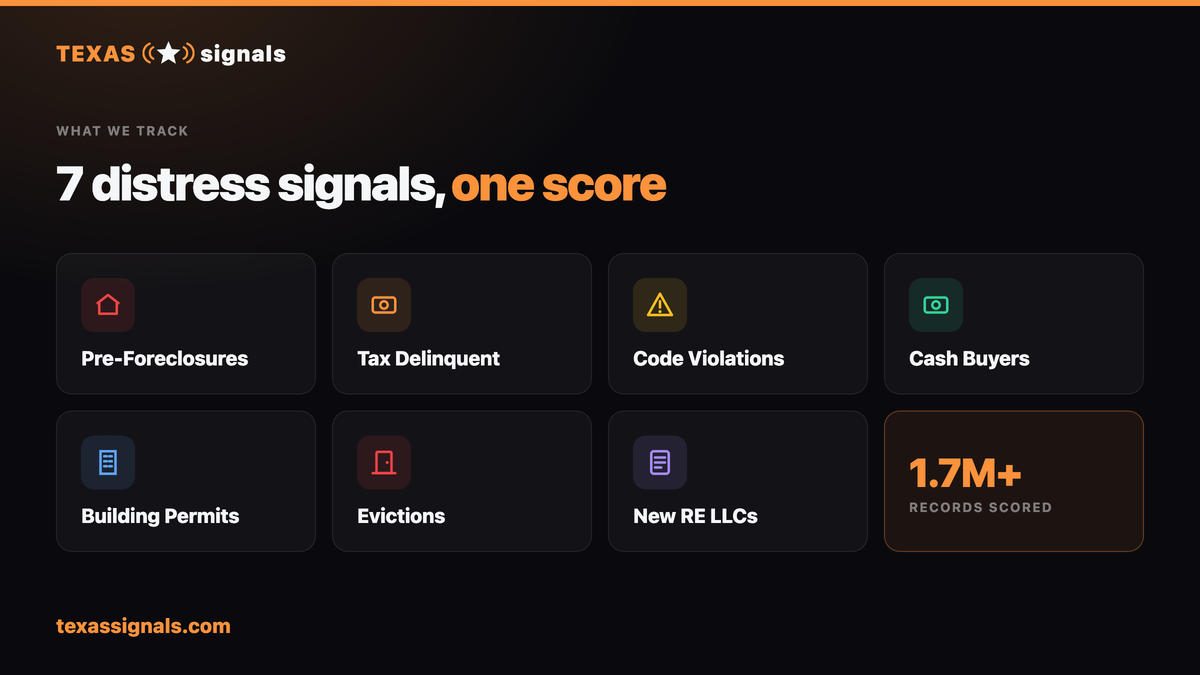
Pre-Foreclosure Filings
Homeowners in pre-foreclosure have a defined timeline (90-180 days) before losing their property. They are motivated to sell, often at a discount, to preserve their credit and extract remaining equity. Texas Signals tracks pre-foreclosures across all five major metros.
Tax Delinquent Properties
Property owners who are behind on taxes face escalating penalties (7% in the first year, plus 2% per month after July 1 in Texas). After two years of delinquency, the county can file suit to seize the property. Owners in this window are motivated to sell.
Code Violations
Properties with active code violations cost money to fix. Owners who receive violation notices — particularly structural or habitability violations — may prefer to sell rather than invest in repairs.
Step 2: Estimate ARV and Repair Costs
ARV (After Repair Value) is the estimated market value of the property after all necessary repairs and renovations. To calculate:
1.Pull comparable sales within 0.5 miles, sold in the last 90 days
2.Filter for similar square footage, bed/bath count, and lot size
3.Adjust for condition differences
4.Average the top 3-5 most relevant comps
Repair estimates require either personal inspection experience or a contractor walkthrough. Common categories:
•Cosmetic ($10-25/sqft): Paint, flooring, fixtures, landscaping
•Moderate ($25-50/sqft): Kitchen/bath remodel, HVAC replacement, roof repair
•Heavy ($50-100+/sqft): Foundation work, structural repair, full gut renovation
Step 3: Calculate Your Offer
The standard wholesale formula:
MAO = ARV x 0.70 - Repairs - Assignment Fee
Example:
•ARV: $300,000
•70% of ARV: $210,000
•Repairs: $40,000
•Your assignment fee: $15,000
•Maximum Allowable Offer: $155,000
Step 4: Build Your Cash Buyer List
Your cash buyer list is your most valuable asset as a wholesaler. Sources:
•Texas Signals cash buyer data — Verified cash transactions with buyer entity names
•County clerk records — Deeds filed without a corresponding mortgage
•Real estate investment clubs — DFW REI Club, Houston REI, SAREIA
•Social media groups — Facebook and BiggerPockets groups for each metro
Step 5: Put It Under Contract
Use a standard TREC (Texas Real Estate Commission) contract with an assignment clause. Key terms:
•Inspection period — Minimum 10 days for due diligence
•Assignment clause — "Buyer may assign this contract to a third party"
•Earnest money — Typically $100-$500 (minimal, as you need to protect downside)
Common Mistakes
1.Overestimating ARV — Use actual sold comps, not active listings
2.Underestimating repairs — Always add 15-20% contingency
3.Not disclosing intent — Texas requires disclosure of assignment plans
4.Marketing the property — Market the contract, not the property
5.Skipping title search — Always verify clear title before contracting
The Data Advantage
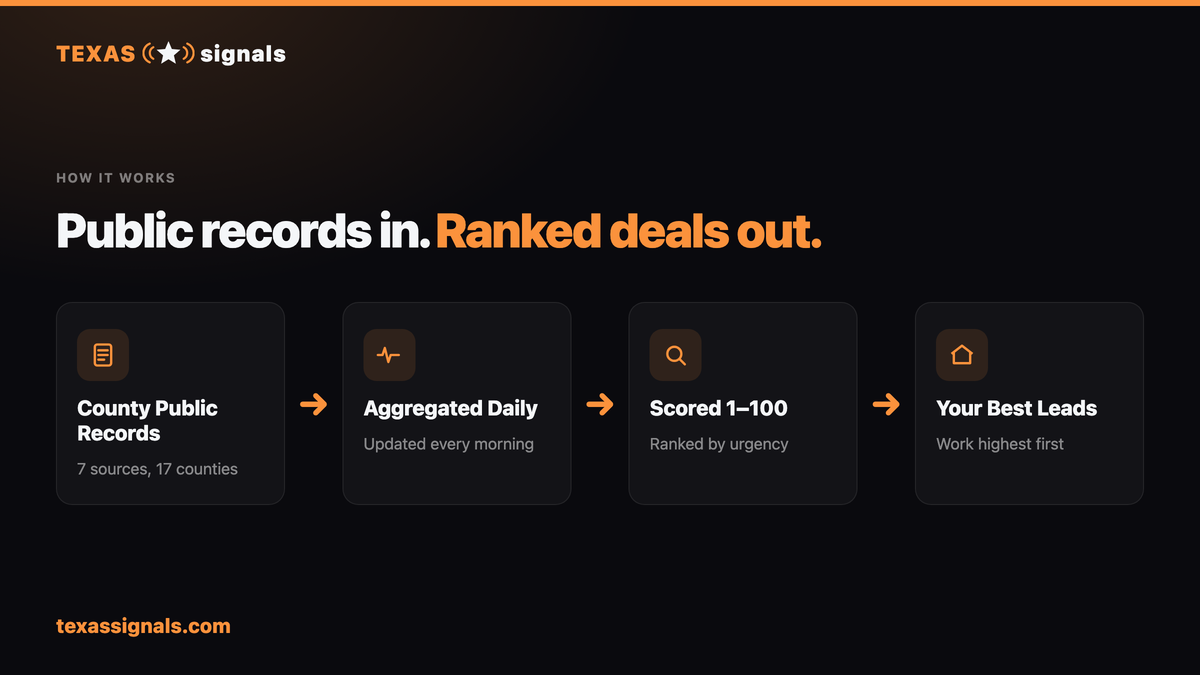
Wholesaling is fundamentally an information arbitrage business. The wholesaler who finds the motivated seller first, with the most accurate data, wins. Texas Signals provides the raw data — pre-foreclosures, tax delinquencies, code violations, and cash buyer lists — that powers this process across Austin, Dallas, Houston, San Antonio, and Fort Worth.
Source: Texas Signals — aggregate county data.
Source: Texas Signals — aggregate county data.
Texas Signals provides the distressed property data that wholesale investors need. Start your free trial at texassignals.com.