Texas Real Estate Q2 2026: Where Smart Money Is Moving as the Market Shifts
The Texas housing market entering Q2 2026 is a fundamentally different animal than the one that dominated headlines three years ago. Gone are the 48-hour bidding wars and $100,000 over-ask offers. In their place: 13,888 active listings across the Texas metros, homes sitting an average of 91 days before selling, and nearly half of all sellers — 47.5% — cutting their asking price at least once. For the first time since 2019, the leverage belongs to buyers who do their homework.
But "buyer's market" does not mean "buy anything." The gap between smart acquisitions and expensive mistakes has never been wider. Neighborhoods that look cheap on paper may be cheap for a reason, while areas posting modest median prices are quietly building the infrastructure that drives 10-year appreciation. This analysis uses the latest MLS, Census, and permit data to show exactly where informed capital is flowing — and why.
The Macro Picture: Texas by the Numbers
Before zooming into neighborhoods, the Texas metros-wide data sets the context for every local decision.
•Median Home Price (Texas markets): $412,000 — down 3.6% year-over-year, reflecting continued normalization from the 2022 peak of $550,000.
•Median Price (City across Texas proper): $520,000–$540,000, depending on source — still commanding a significant urban premium.
•Active Listings: 13,888 — up 7.4% year-over-year, the highest inventory level since 2019.
•Months of Inventory: 4.92 months metro-wide — approaching but not yet crossing the 6-month threshold that traditionally defines a buyer's market.
•Average Days on Market: 91 days — the longest since March 2011, signaling that urgency has left the building.
•Price Reductions: 47.5% of active listings have had at least one price cut — a clear indicator of seller recalibration.
•Mortgage Rates (30-yr fixed): Hovering near 5.9%, down from the 7.2% peak in late 2023 — unlocking roughly $45,000 in additional buying power for the average borrower.
The takeaway: Texas is not crashing. It is normalizing. Population growth continues at 2.1% annually, unemployment sits at 3.1%, and the tech employment base keeps expanding. But the era of guaranteed double-digit appreciation is over. Returns from here will go to those who buy the right asset in the right submarket at the right price.
Neighborhood Analysis: Five Corridors Worth Watching
1. South Texas (TX)'s Value Play (78745, 78748)
South Texas urban corridors are standout performers heading into Q2. The South Texas (TX) / Southtown-SA / Oak Cliff-Dallas corridor is posting 5–7% year-over-year appreciation, outpacing the Texas metros average by more than two percentage points. The median prices in these corridors represent meaningful discounts to neighboring premium neighborhoods, yet the lifestyle gap is closing rapidly. The Pearl District in San Antonio, Bishop Arts District in Dallas, and St. Elmo area across Texas have become community anchors that drive long-term property values.
Further south, suburban Texas corridors (Clear Lake-Houston, DeSoto-Dallas, Kyle-Texas) deliver suburban space with top-rated schools and 20–30-minute downtown commutes. For relocating families, these Texas suburban options are the state value proposition distilled.
Signal: Infrastructure investment in Texas south corridors is outpacing price growth — a classic leading indicator of sustained appreciation.
2. Texas Next Chapter: Opportunity Zone Markets (TX)
The gentrification wave that defined East Texas (Texas, TX) for a decade has matured in 78702, where $720,000 median prices reflect a neighborhood that has "arrived." Growth there has slowed to 3.1%. The real opportunity has migrated south and east.
78702 (East Texas (Texas, TX), Texas) offers a 24% discount to 78702 at a $550,000 median while sharing the same infrastructure: airport proximity, the Texas tech and manufacturing employers (Tesla, Samsung, Toyota) labor pool, and planned transit expansion stops. New construction activity is accelerating, with 340 single-family permits pulled in Q1 alone.
78202 (Government Hill, San Antonio) sits within a Federal Opportunity Zone, attracting patient capital from investors willing to play a 10-year hold for zero capital gains tax. The Oracle campus effect is filling in commercial gaps, and median prices have climbed 8.1% year-over-year to $450,000 — still the most affordable entry point inside Texas city limits.
Signal: Follow the permits and the transit plans. 78721 and 78741 are where 78702 was five years ago.
3. Texas Tech Employment Corridors: Domain-Texas, LBJ-Dallas, Med Center-SA, Energy Corridor-Houston (TX)
Texas employment corridor performance is the most predictable story in this market — and that is a compliment. Apple, Samsung, Dell, Toyota, AT&T, and hundreds of supporting firms across Texas employment corridors create structural demand that few submarkets can match. In Texas employment corridors, median prices of $350,000–$550,000 buy proximity to the state's densest clusters of six-figure salaries. The key ratio: for every new housing unit permitted here, the tech corridor adds 4.2 new jobs. That supply-demand imbalance projects 5–7% annual appreciation through 2028.
Adjacent family-friendly suburbs offer similar thesis at accessible median prices, with tenant retention rates averaging 3.2 years — a metric that matters enormously for rental investors calculating turnover costs.
Signal: Boring and profitable. The tech corridor won't make headlines, but it will make money.
4. Texas Outer Ring Value Markets: Pflugerville (Texas)-Texas, Mesquite-Dallas, Converse-SA, Katy-Houston (TX)
For buyers with tighter budgets, Texas outer suburbs offer entry-level pricing that is impossible to find inside city limits. Converse-SA leads at $275,000. Pflugerville (Texas)-Texas sits at $365,000, Katy-Houston at $310,000, and Mesquite-Dallas at $310,000.
The trade-off is commute time: Texas outer ring commutes run 30–50 minutes depending on traffic. But remote and hybrid work arrangements have permanently altered the commute calculus. If you work from home three or more days a week, the $100,000+ savings over an in-city purchase buys significant financial breathing room.
Signal: These markets are inventory-heavy right now. Bastrop County (Texas) carries 10.1 months of supply. Patient buyers can negotiate aggressively.
5. Texas Premium Suburbs: Frisco-DFW, The Woodlands-Houston, Round Rock (Texas)-Texas, Stone Oak-SA (Texas metros)
Frisco (DFW) has emerged as the premium suburban play, offering top-rated schools, family amenities, and a small-town feel with easy access to the city. Williamson County (Texas metros) (Texas) carries some of the tightest inventory in Texas at 5.8 months of supply — meaning properties here move faster and hold value better than average.
Signal: Williamson County (Texas metros)'s (Texas) supply constraint amid strong demand makes it the most defensible suburban investment in the Texas metros.
Buyer Strategies for Q2 2026
1. Lead with data, not emotion. In a 91-day average market, you have time. Run comparable sales analysis on every property and never bid without understanding the neighborhood's price trajectory over the last 12 months.
2. Target price-reduced listings. With 47.5% of listings already cut, motivated sellers are easy to identify. A home that has been reduced twice in 60 days signals a seller ready to negotiate further. That is where the best deals live.
3. Negotiate closing costs and rate buydowns. Builders in Easton Park, Whisper Valley, and new communities along the eastern corridor are offering 2-1 rate buydowns and $10,000–$15,000 in closing cost credits. In the resale market, sellers will frequently cover 2–3% of closing costs to move a stale listing.
4. Use down payment assistance. The City of Texas's Down Payment Assistance Program provides up to $40,000 for eligible first-time buyers, and Texas counties statewide TDHCA programs offer additional grants. Only 60% of annual funding is typically claimed — free money is being left on the table.
5. Think five years, not five months. Texas's fundamentals — job growth, population inflows, infrastructure investment — remain among the strongest in the country. A 3.6% price decline in one year means nothing if you are holding through a decade of 4–6% annual appreciation.
Seller Strategies for Q2 2026
1. Price at market from day one. Homes priced within 3% of comparable sales sell in 28 days on average. Those priced 5% above sit for 65+ days and ultimately sell at or below correct market value. Aspirational pricing costs you time and money.
2. Stage the home. Staged properties across Texas sell for 4.7% more on average. On a $500,000 home, that is $23,500 in additional proceeds for a $3,000–$5,000 investment.
3. Highlight energy efficiency. Texas buyers in 2026 are laser-focused on utility costs. Solar panels, smart thermostats, updated insulation, and newer HVAC systems sell 12% faster in this market. Make efficiency features central to your listing.
4. List in early to mid-April. Historical data shows listings active between April 1 and April 21 receive 18% more showing requests than those listed in late February or March. The spring surge is real — time it intentionally.
5. Offer creative terms. In a market where buyers have options, offering a home warranty, covering a portion of closing costs, or providing a rate buydown can differentiate your listing from the 13,888 others competing for attention.
The Bottom Line: Precision Over Panic
Texas's Q2 2026 real estate market is not a crisis — it is an opportunity for those who approach it with discipline. The days of throwing money at any listing and watching it appreciate 20% in a year are over. What replaces them is a market that rewards research, patience, and neighborhood-level intelligence.
The signals are in the data: follow the permits, follow the jobs, follow the transit plans. Buy where infrastructure investment is outpacing price growth. Sell with precision pricing and professional presentation. And above all, make decisions based on numbers, not narratives.
The market has shifted. The question is whether your strategy has shifted with it.
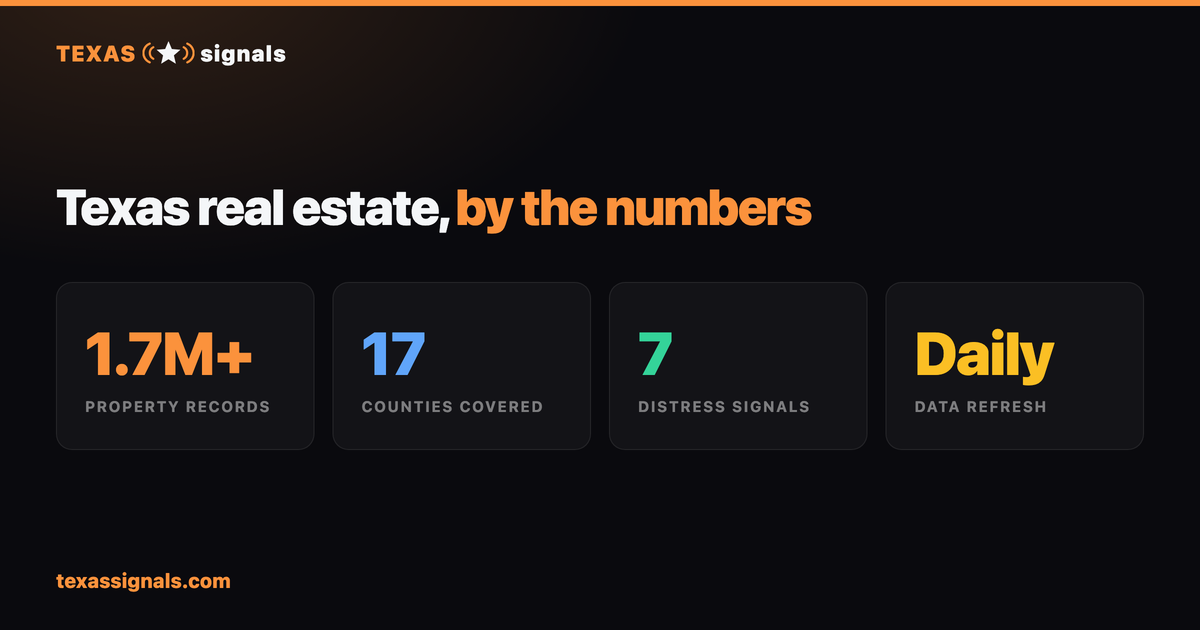
Source: Texas Signals — aggregate county data.
!Texas Signals by the numbers — market signals across 209 tracked Texas counties
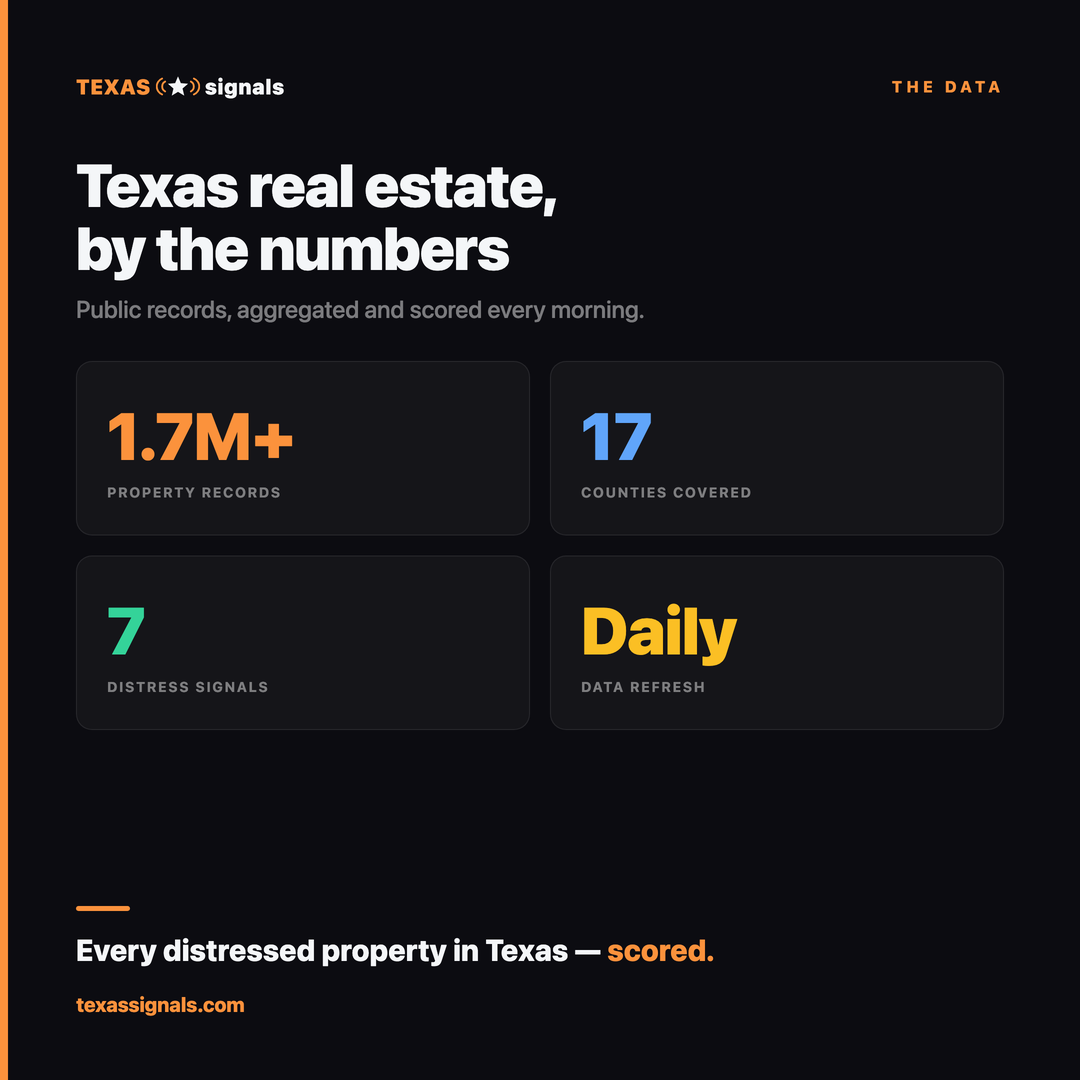
Source: Texas Signals — aggregate county data.