Texas Signals
← Back to Blog

Texas Foreclosure Auction Calendar 2026: First Tuesday Sales Guide

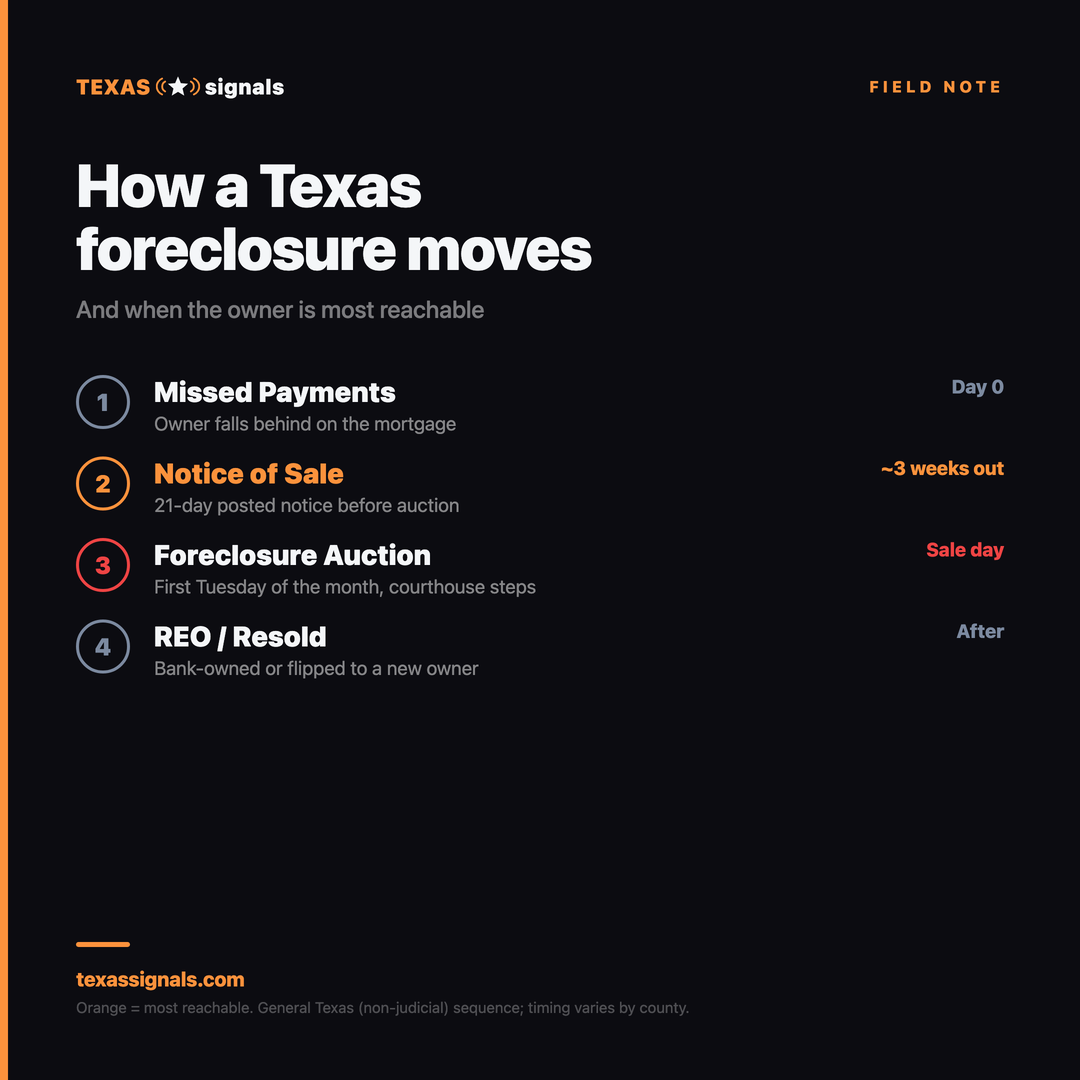
In Texas, every foreclosure auction happens on the same day: the first Tuesday of the month. No exceptions. Whether it's a mortgage foreclosure, a tax sale, or an HOA lien sale, the auction takes place at the county courthouse between 10:00 AM and 4:00 PM on First Tuesday. This predictable schedule is one of the things that makes Texas unique for real estate investors — and one of the reasons preparation matters more than showing up. This guide covers every remaining 2026 auction date, how the process works, what you need to know before you bid, and how to research properties ahead of time.

2026 Remaining Auction Dates

Every date below falls on the first Tuesday of the month. Mark your calendar — these are the only days foreclosure auctions occur in Texas.

  • June 2, 2026 — Filings due by May 12 (21-day notice requirement)
  • July 7, 2026 — Filings due by June 16
  • August 4, 2026 — Filings due by July 14
  • September 1, 2026 — Filings due by August 11
  • October 6, 2026 — Filings due by September 15
  • November 3, 2026 — Filings due by October 13
  • December 1, 2026 — Filings due by November 10

The “filings due by” date is the last day a Notice of Trustee's Sale can be filed and still meet the 21-day minimum notice requirement. Properties filed after that cutoff get pushed to the following month's auction. This is important because it means the pool of properties for any given First Tuesday is locked in roughly three weeks in advance — giving you a defined research window.

How Texas Foreclosure Auctions Work

The foreclosure auction process in Texas is governed by the Texas Property Code, Sections 51.002 through 51.009. Here's the step-by-step breakdown of what happens on auction day and the process leading up to it.

The Notice of Trustee's Sale

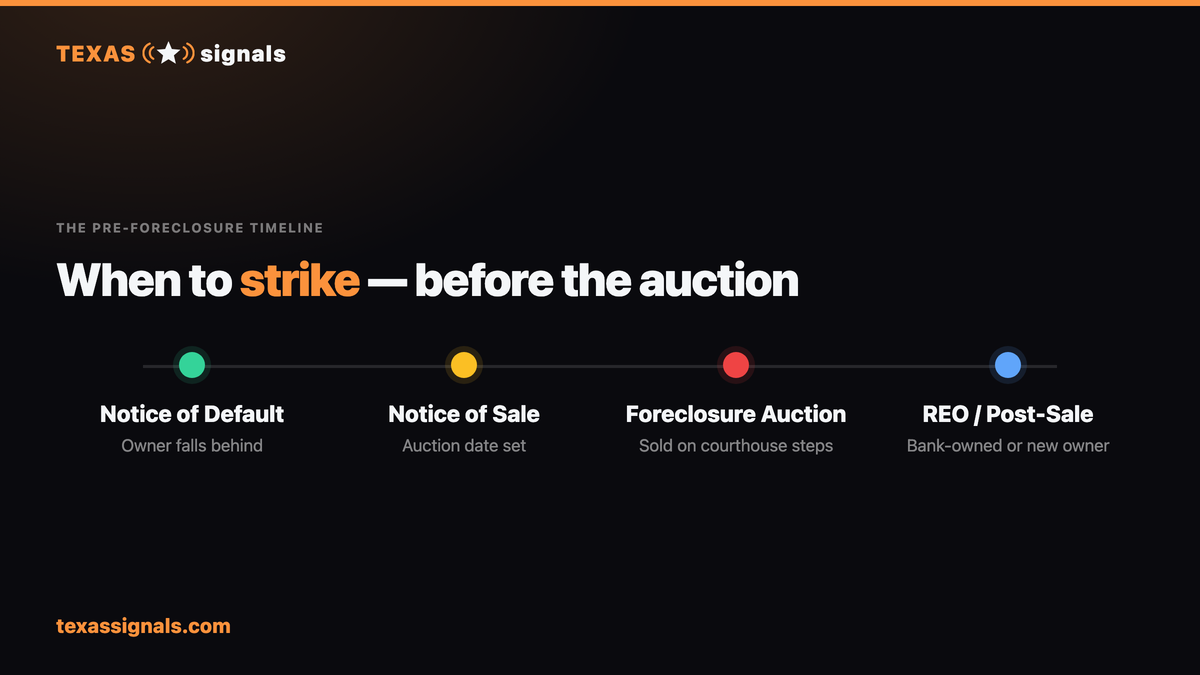
Before any property can be auctioned, the trustee (appointed in the original deed of trust) must file a Notice of Trustee's Sale with the county clerk at least 21 days before the sale date. This notice must also be posted at the courthouse door and mailed to the borrower by certified mail. The notice includes the property address, legal description, and the date, time, and location of the sale.

This filing is a public record — and it's the starting gun for investors. Once the Notice of Trustee's Sale is filed, the property is confirmed for the next First Tuesday auction unless the owner cures the default, files for bankruptcy, or the lender agrees to postpone.

Auction Location

Each county designates a specific area at or near the courthouse for foreclosure sales. In larger counties, this is often an outdoor area near the courthouse steps (hence the term “courthouse steps auction”). Some counties have moved auctions to designated indoor areas or nearby buildings. Check your county's website or call the county clerk's office to confirm the exact location.

For the major metros: Travis County conducts sales at the George Williamson County Building area, Harris County at the Civil Courthouse on Franklin Street, Dallas County at the George Allen Sr. Courts Building, and Bexar County at the Bexar County Courthouse. Locations can change, so verify before auction day.

Auction Hours

Sales can occur any time between 10:00 AM and 4:00 PM. In practice, most auctions begin between 10:00 AM and 11:00 AM, but the trustee has the right to conduct the sale at any point during the six-hour window. Arrive early and plan to stay.

The Bidding Process

The trustee calls out each property, reads the legal description, and opens bidding. The lender typically submits a credit bid equal to the outstanding loan balance (they don't need cash — they're bidding their own debt). If no one outbids the lender, the property becomes REO (Real Estate Owned) and goes into the lender's inventory.

If a third-party bidder wins, they must pay the full bid amount immediately. This is not a deposit. The full purchase price is due at the conclusion of bidding. The trustee will issue a Trustee's Deed to the winning bidder, typically within a few days.

What You Need to Bring

Coming unprepared to a First Tuesday auction is a recipe for wasted time or expensive mistakes. Here's your checklist.

Payment

Cashier's checks or cash only. No personal checks, no wire transfers, no credit cards. Most investors bring multiple cashier's checks in different denominations so they can cover various bid amounts. Some counties accept a single cashier's check made payable to the trustee; others require specific payee formatting. Confirm with the trustee or their law firm before auction day.

A common strategy: bring cashier's checks in denominations of $10,000, $25,000, $50,000, and $100,000. You can combine checks to reach your total bid. Unused checks go back to your bank. The key is having enough liquidity on hand to cover your maximum bid — if you win and can't pay, you lose the property and may face legal liability.

Property Research Folder

For each property you're considering bidding on, bring a printed folder containing: the Notice of Trustee's Sale, the CAD property record (showing appraised value, lot size, square footage, year built), any title research you've conducted, your maximum bid calculation, and photos from your drive-by inspection.

Valid Identification

Bring a government-issued photo ID. The trustee will need it to process the sale and prepare the deed.

Critical Rules: Buyer Beware

Texas foreclosure auctions are caveat emptor — buyer beware in the most literal sense. Understanding these rules is non-negotiable before you bid.

No Interior Inspection

You cannot inspect the inside of the property before the auction. The current occupant (whether the borrower, a tenant, or a squatter) has no obligation to let you in. You are buying based on exterior observation, public records, and whatever information you can gather from neighbors or the occupant (if they're willing to talk). Budget conservatively for repairs — assume the interior is worse than the exterior suggests.

No Title Insurance at Closing

A trustee's deed is not the same as a warranty deed. Title companies will not issue title insurance on a trustee's deed at the time of sale. You'll need to obtain title insurance later, which typically requires a waiting period (60-90 days in most cases) and a clean title search. Some investors purchase a title search before the auction to identify potential issues — this costs $200-$500 and is money well spent.

Surviving Liens

The foreclosure wipes out the foreclosing lien and any junior liens (liens recorded after the foreclosing deed of trust). However, senior liens survive. If there's a first mortgage being foreclosed, any second mortgage or HELOC is wiped out. But if a second mortgage is being foreclosed, the first mortgage survives — and you're buying the property subject to that first mortgage.

Additionally, property tax liens always survive a mortgage foreclosure. If the property has delinquent taxes, you're responsible for them. IRS liens survive if the IRS wasn't properly notified of the sale (and even if they were, the IRS has a 120-day right of redemption). HOA liens and mechanic's liens may or may not survive depending on their priority.

Bottom line: Run a title search before you bid. The $300 you spend could save you from inheriting a $150,000 senior lien you didn't know about.

Occupancy and Eviction

If the former owner or a tenant is still living in the property after the auction, you'll need to go through the formal eviction process. In Texas, this starts with a 3-day notice to vacate, followed by filing a forcible detainer suit in Justice of the Peace court if the occupant doesn't leave. The process typically takes 3-6 weeks from start to finish, assuming no appeals.

How Many Properties Are Heading to Auction

The Texas Signals database currently tracks 27,799 pre-foreclosure records across seven counties. Of those, a significant portion have confirmed auction dates set for upcoming First Tuesdays. The exact number shifts daily as new Notices of Trustee's Sale are filed, existing filings are cancelled (when owners cure the default), and auctions are postponed.

Harris County consistently leads in volume, with Dallas County second. Travis County has seen a notable increase in 2026 filings, driven by adjustable-rate mortgage resets and declining short-term rental income that has squeezed overleveraged investors. Tarrant, Bexar, Collin, and Denton counties round out the coverage.

The key insight: First Tuesday auction pools are knowable in advance. Because the Notice of Trustee's Sale must be filed at least 21 days before the sale, you have a minimum three-week window to research every property in the pool. Most serious auction buyers spend those three weeks running title searches, driving properties, analyzing CAD records, and calculating maximum bids. Showing up unprepared on auction day is how investors overpay or buy problems.

How to Prepare: A 21-Day Research Timeline

Once you know which properties are set for the next First Tuesday, follow this preparation timeline.

Days 21-14: Initial Screening

Pull the full list of properties with confirmed auction dates from the Texas Signals auction calendar. Filter by your target criteria: location, property type, estimated equity, and Intelligence Score. Narrow from the full pool to your short list of 10-20 properties worth deeper research.

Days 14-10: Title and Lien Research

Order preliminary title searches on your short-listed properties. Identify the foreclosing lien position (first or junior), check for delinquent taxes, IRS liens, HOA liens, and mechanic's liens. Eliminate any property where surviving liens would erode your margin.

Days 10-5: Drive-By Inspections

Visit every remaining property on your list. Photograph the exterior from multiple angles. Note the condition of the roof, windows, siding, yard, and any visible structural issues. Talk to neighbors if possible — they can tell you whether the property is occupied, how long it's been deteriorating, and sometimes even the owner's situation.

Days 5-1: Final Bid Calculations

For each property you plan to bid on, calculate your maximum allowable offer (MAO). A common formula: ARV x 70% - repair costs - holding costs = MAO. The After Repair Value (ARV) should be based on comparable sales within the past 90 days, not the CAD appraised value (which often lags the market). Build in a margin of error — if your MAO is $180,000, set your maximum bid at $170,000 to account for unknowns.

Day 0: Auction Day

Arrive at the courthouse by 9:30 AM. Bring your cashier's checks, property folders, ID, and a pen. Listen to the trustee's announcements — properties are frequently cancelled, postponed, or removed from the auction at the last minute. Stick to your maximum bids. The worst thing you can do at a foreclosure auction is let competition push you past your number. There will always be another First Tuesday.

The Texas Signals Auction Calendar

Texas Signals maintains a live auction countdown calendar that shows every property with a confirmed auction date. Each listing includes the property address, auction date, days remaining, CAD appraised value, estimated equity, Intelligence Score, and links to the original Notice of Trustee's Sale filing.

The calendar updates daily as new filings are recorded and existing auctions are cancelled or postponed. You can filter by county, auction month, minimum equity, and property type. Set up alerts to get notified when new properties are added to upcoming First Tuesday pools in your target areas.

The advantage of using a consolidated database over manually checking county records is time. Across seven counties, there are thousands of filings to review. Texas Signals does the aggregation, enrichment, and scoring so you can spend your time on the work that actually matters: evaluating deals and preparing bids.

Start Researching Before the Next First Tuesday

The next Texas foreclosure auction is June 2, 2026. Properties are already being filed for that sale. The 21-day notice window means filings submitted by May 12 are confirmed for June's First Tuesday. Every day between now and then is time you can use to research, evaluate, and prepare.

Start your 7-day free trial to access the live auction calendar, property-level research tools, and daily filing updates across all tracked Texas counties. Know what's coming before the courthouse crowd does.

See this data live in your dashboard
Texas Signals tracks 1.1M+ property records across 5 metros and 7 counties. 7-day free trial, no credit card required.
Start Free Trial

More from Texas Signals

Product

Getting Started with Texas Signals: Your First 7 Days

May 30, 2026 · 6 min read
Investing

Tax Delinquent Property Investing in Texas: Complete 2026 Guide

May 29, 2026 · 8 min read
Market Intelligence

Texas Foreclosure Auction Calendar 2026: First Tuesday Sales Guide

May 29, 2026 · 7 min read
Data & Research

Texas Pre-Foreclosure List 2026: Every County, Updated Daily

May 29, 2026 · 8 min read
View all articles →