Tax Delinquent Property Investing in Texas: Complete 2026 Guide
Every year, thousands of Texas property owners fall behind on their property taxes. When that happens, a clock starts ticking — penalties accumulate, interest compounds, and eventually the county or a taxing authority can force a sale to recover what's owed. For investors who understand the process, tax delinquent properties represent one of the most consistent deal pipelines in the state. This guide covers the entire lifecycle, from the first missed payment to the courthouse sale, and shows you how to use data to find the best opportunities.
What Are Tax Delinquent Properties?

A tax delinquent property is any parcel where the owner has failed to pay property taxes by the deadline. In Texas, property taxes are due by January 31 of each year. If the owner doesn't pay by that date, the account becomes delinquent on February 1, and penalties begin accruing immediately.
Tax delinquency is distinct from mortgage foreclosure. A property can be tax delinquent even if the mortgage is current — the owner may be making house payments but ignoring the tax bill. Conversely, a property in mortgage foreclosure may have fully paid taxes. The two processes run on separate tracks, though they often overlap on the most distressed properties.
Why does this matter for investors? Because tax delinquency is a leading indicator of motivation. An owner who can't or won't pay their property taxes is signaling financial distress, disengagement from the property, or both. That signal becomes stronger the longer the delinquency persists and the more money that's owed.
The Texas Property Tax Delinquency Timeline
Texas has one of the most aggressive penalty structures in the country. Understanding the timeline is critical because it tells you exactly how much pressure the owner is under at any given point.
February 1: Delinquency Begins
The day after the January 31 deadline, the account becomes delinquent. A 6% penalty is added immediately, plus 1% interest. The total cost on day one is already 7% of the tax bill.
March Through June: Penalties Escalate Monthly
Each month, an additional 1% penalty is added on top of the ongoing 1% monthly interest. By March 1, the penalty is 7% plus 2% interest. By April 1, it's 8% plus 3% interest. By June 1, the penalty reaches 10% and interest hits 5%, bringing the total surcharge to 15% of the original tax bill.
July 1: Attorney Fees Kick In
This is the inflection point. On July 1, if the taxes remain unpaid, the taxing unit's delinquent tax attorney adds an additional 15-20% collection penalty on top of the existing penalties and interest. The total cost of delinquency now approaches 30-35% of the original tax bill. For a property with a $6,000 annual tax bill, the owner now owes roughly $8,000 — and the meter is still running.
Year 2 and Beyond: Compounding Continues
Interest continues at 1% per month (12% annually) on the outstanding balance, including penalties. A property that's two years behind on a $6,000 annual bill can easily owe $18,000-$20,000 when you account for two years of taxes plus cumulative penalties, interest, and attorney fees. Three years behind, and the total can exceed $30,000.
Tax Suit and Judgment
The taxing authority (county, school district, city, or special district) can file a tax suit against the property owner at any time after delinquency. In practice, most jurisdictions wait 1-3 years before filing suit, though some are more aggressive. Once a judgment is obtained, the court orders the property sold at a public auction to satisfy the tax debt.
Tax Lien Sales vs. Tax Deed Sales in Texas
Texas operates as a tax deed state, not a tax lien state. This is an important distinction that many out-of-state investors misunderstand.
How Tax Deed Sales Work
In a tax deed sale, the property itself is sold to satisfy the tax debt. The winning bidder receives a deed to the property, not a lien certificate. The minimum bid is typically the total amount of taxes, penalties, interest, attorney fees, and court costs owed. If the bidding exceeds that amount, the excess (called “surplus funds”) goes to the former owner.
Tax deed sales in Texas are conducted by the county sheriff or constable, usually at the county courthouse. They follow the same first Tuesday of the month schedule as mortgage foreclosure auctions, and in many counties, they happen at the same location.
The Redemption Period
Here's the catch that trips up new investors: Texas gives the former owner a right of redemption. For most residential properties, the redemption period is two years from the date of sale. For non-homestead and non-agricultural properties, it's 180 days.
During the redemption period, the original owner can reclaim the property by paying the purchaser the amount paid at sale, plus a 25% premium (if redeemed within the first year) or a 50% premium (if redeemed in the second year). While 25-50% sounds like a guaranteed return, you're tying up capital with no guarantee the owner will actually redeem. If they don't redeem, you own the property — which may or may not be a good outcome depending on condition and title.
Current Data: 189,027 Tax Delinquent Records
The Texas Signals database currently contains 189,027 tax delinquent property records across all tracked counties. That number represents properties with at least one year of unpaid taxes as reported by county tax assessor-collector offices and appraisal districts.
Not all of these are actionable investment opportunities. Many are minor delinquencies on low-value parcels, or properties where the owner is on a payment plan. The value of having the complete dataset is the ability to filter aggressively and surface only the properties that match your criteria.
For context, the breakdown by metro area shows Harris County (Houston) leading with the highest volume, followed by Dallas County, Bexar County (San Antonio), Tarrant County (Fort Worth), and Travis County (Austin). Rural counties contribute a meaningful share as well, often with lower competition among buyers.
How to Evaluate Tax Delinquent Properties
Finding tax delinquent properties is the easy part. Evaluating them correctly is what separates profitable investors from those who buy problems. Here are the key factors to analyze.
Years Behind on Taxes
The number of years delinquent is a direct measure of motivation and neglect. A property one year behind might just be a late payer who will catch up. A property three or more years behind signals a serious problem — the owner either can't afford the taxes, doesn't care about the property, or both. Properties 3+ years behind are approaching or already in tax suit territory, which creates urgency.
Amount Owed
The total delinquent amount matters in two ways. First, it tells you the minimum you'd need to bid at a tax sale. Second, it affects your negotiation with the owner if you're buying pre-sale. An owner who owes $45,000 in back taxes on a $200,000 property is in a very different position than one who owes $3,000 on the same property.
Equity Position
Cross-reference the tax debt with the property's CAD appraised value and any outstanding mortgage liens. A property appraised at $250,000 with a $120,000 mortgage and $30,000 in back taxes still has roughly $100,000 in equity. That equity is the owner's incentive to act — they'd rather sell to you at a discount than lose everything at a tax sale. Properties with no mortgage and high equity are particularly attractive because the owner can walk away with cash even after settling the tax debt.
Property Condition
Tax delinquent properties are disproportionately likely to have deferred maintenance. Check for active code violations — these are publicly filed and often indicate broken windows, overgrown lots, structural issues, or utility shutoffs. Also review the CAD's improvement value trend. If the improvement value has been declining while the land value holds steady, the structure is deteriorating.
Drive-by inspections are essential before making any offer. Google Street View can give you a starting point, but it's often outdated. There is no substitute for seeing the property in person.
Occupancy Status
Is the property owner-occupied, tenant-occupied, or vacant? Vacant tax delinquent properties are the easiest to acquire because there's no one living there who needs to be relocated. Owner-occupied properties require more sensitivity — you're dealing with someone in financial distress. Tenant-occupied properties add complexity around existing lease agreements, which survive a change of ownership in most cases.
Three Strategies for Tax Delinquent Properties
Strategy 1: Buy at the Tax Sale
Attend the county tax sale on the first Tuesday and bid on properties. The minimum bid covers all taxes, penalties, interest, and fees owed. Properties that receive no bids are “struck off” to the taxing authority, which then holds them and may re-offer them later at reduced prices.
Pros: You acquire the deed directly. If no one redeems, you own the property free of the tax lien. Strike-off properties can sometimes be acquired for pennies on the dollar.
Cons: The redemption period creates uncertainty. You're buying sight-unseen (no interior access). Title issues are common — you'll typically need a quiet title action before you can sell or finance the property, which costs $2,000-$5,000 and takes 3-6 months.
Strategy 2: Negotiate Directly with the Owner Pre-Sale
This is the highest-margin strategy. Contact the owner before the tax sale and negotiate a purchase. You can structure the deal to pay off the back taxes at closing (through the title company) and acquire the property with a clean title — no redemption period, no quiet title action needed.
The key advantage is that the owner's alternative is losing the property entirely at the tax sale. Your offer, even at 60-70% of market value, puts cash in their pocket and eliminates the tax debt. Many owners in this situation are relieved to have a way out.
Data tip: Use Texas Signals to filter for properties with 3+ years delinquent, high equity, and no active mortgage. These owners have the most equity to protect and the fewest reasons to hold on.
Strategy 3: Wholesale the Opportunity
If you don't have the capital to buy, you can put the property under contract and assign the contract to another investor. Tax delinquent properties with clear equity spreads are highly attractive to cash buyers. Your assignment fee comes from the gap between your contract price and what the end buyer is willing to pay.
Risk Factors to Watch
Tax delinquent investing is not without risk. Here are the main pitfalls:
- Redemption period — If you buy at a tax sale, the former owner has up to two years to reclaim the property. You'll get your money back plus 25-50%, but you can't improve or rent the property with confidence during that window.
- Title issues — Tax deeds do not come with title insurance. Outstanding liens (other than the tax lien) may or may not survive the sale depending on whether the lienholder was properly notified. Budget for a quiet title action.
- Condition unknowns — You cannot inspect the interior before a tax sale. Foundation problems, mold, asbestos, and environmental contamination are all possibilities. Factor repair costs conservatively.
- IRS liens — Federal tax liens survive a Texas tax sale. The IRS has 120 days after the sale to redeem the property. Always check for federal liens before bidding.
- Heir properties — Many long-delinquent properties are owned by deceased individuals, with multiple heirs who may or may not know they have an interest. Negotiating with heir properties requires patience, skip tracing, and often probate work.
How Texas Signals Helps You Find Tax Delinquent Deals
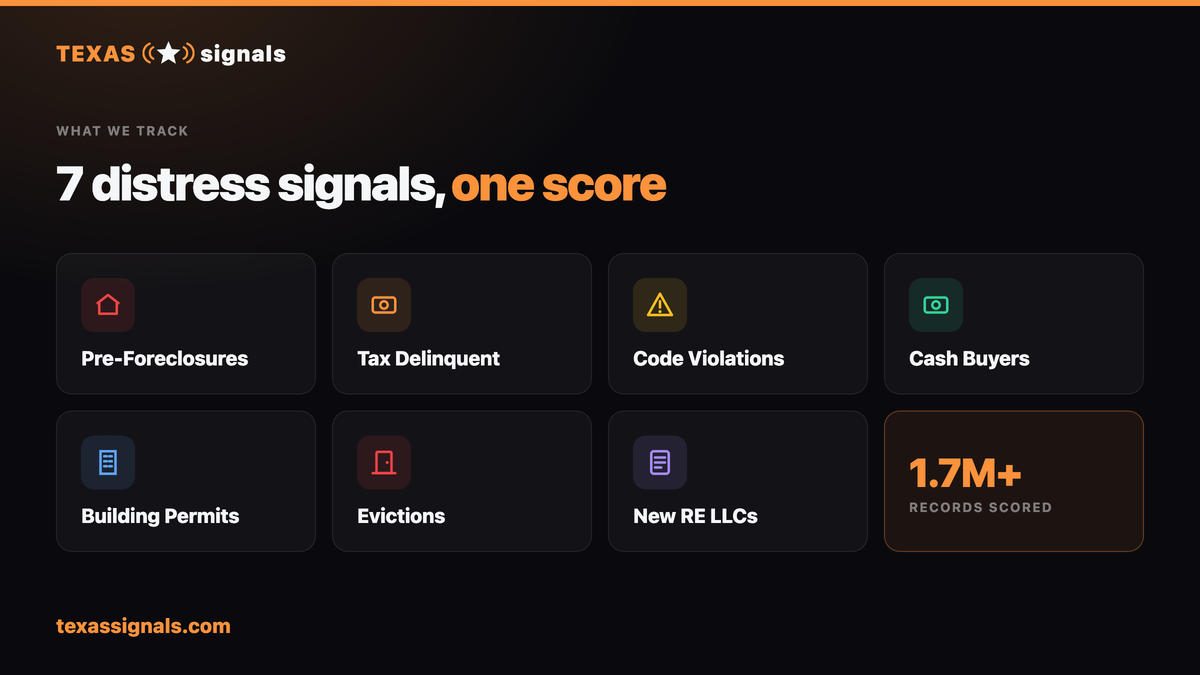
Texas Signals aggregates tax delinquency data from county tax assessor-collector offices and cross-references it with CAD records, mortgage filings, code violations, and pre-foreclosure data. The result is a filterable database where you can search by:
- Years delinquent — Filter for 1, 2, 3, or 4+ years behind.
- Amount owed — Set minimum and maximum delinquent amounts.
- Estimated equity — Focus on properties where the CAD value minus liens exceeds your target threshold.
- City and zip code — Narrow to your target market.
- Intelligence Score — Our composite score combines tax delinquency with other distress signals (pre-foreclosure, code violations, value decline) to rank overall motivation from 1 to 100.
Every record includes the property address, owner name, CAD appraised value, 3-year value history, tax delinquent amount, years behind, and links to the original county records. Properties with multiple distress signals — for example, tax delinquent and in pre-foreclosure and with code violations — rise to the top of the Intelligence Score rankings.
Get Started with Tax Delinquent Data Today
With 189,027 tax delinquent records in the database and more counties being added regularly, Texas Signals gives you the most comprehensive view of tax-distressed properties in the state. Stop searching county websites one at a time. Start filtering the entire dataset by the metrics that actually matter.
Start your 7-day free trial to access the full tax delinquent property database with daily updates, CAD enrichment, and Intelligence Scoring across all tracked Texas counties.