How to Find Wholesale Deals in Texas: A Data-Driven Guide
Texas is the best state in the country for wholesale real estate. No state income tax, a non-judicial foreclosure process that moves fast, strong population growth driving housing demand, and a legal framework that is favorable to real estate assignment contracts. But finding deals — consistently, at scale — requires more than driving for dollars and sending direct mail to every address in a zip code. The wholesalers who are closing the most deals in 2026 are using data to identify motivated sellers before their competition even knows a property is distressed.
Why Texas Is Built for Wholesaling
Before diving into deal-finding strategies, it is worth understanding why Texas produces more wholesale opportunities than almost any other state.
Population growth. Texas added over 470,000 new residents in 2025 alone. That growth creates constant demand for housing, which means there is always a buyer for a property you put under contract — the fundamental requirement for wholesaling to work.
Non-judicial foreclosure. Texas allows lenders to foreclose without going through the courts, which means the pre-foreclosure timeline is compressed to as little as 21 days from the Notice of Sale to the auction. That compressed timeline creates urgency for homeowners, which translates directly into motivated sellers.
No state income tax. Your wholesale assignment fees are not taxed at the state level. Combined with relatively low cost of living in most Texas metros, this means your margins are higher than wholesalers operating in states like California or New York.
Diverse metro markets. Houston, Dallas-Fort Worth, Austin, and San Antonio each have distinct market dynamics, price points, and investor pools. A wholesaler in Texas can work multiple metros from a single operation, diversifying their deal flow across different market cycles.
Traditional Methods vs. Data-Driven Wholesaling
Traditional wholesaling relies on a few well-known lead generation methods: driving for dollars (looking for physically distressed properties), direct mail to absentee owners, bandit signs, and cold calling probate leads. These methods still work — but they are inefficient. You are casting a wide net and hoping to find the one motivated seller among hundreds of uninterested homeowners.
Data-driven wholesaling inverts the process. Instead of starting with a geographic area and hoping to find distress, you start with the distress signal and work backward to the property. When you know which homeowners have a foreclosure filing, three years of delinquent taxes, and an active code violation on their property, you are not guessing about motivation — you are contacting someone who has multiple documented reasons to sell quickly.
The difference in conversion rates is dramatic. Traditional direct mail campaigns to absentee owners convert at 0.5-1% on a good day. Targeted outreach to homeowners with verified distress signals converts at 3-5% — five to ten times higher. At scale, that difference is the difference between closing one deal a month and closing one deal a week.
Six Data Sources That Reveal Wholesale Opportunities
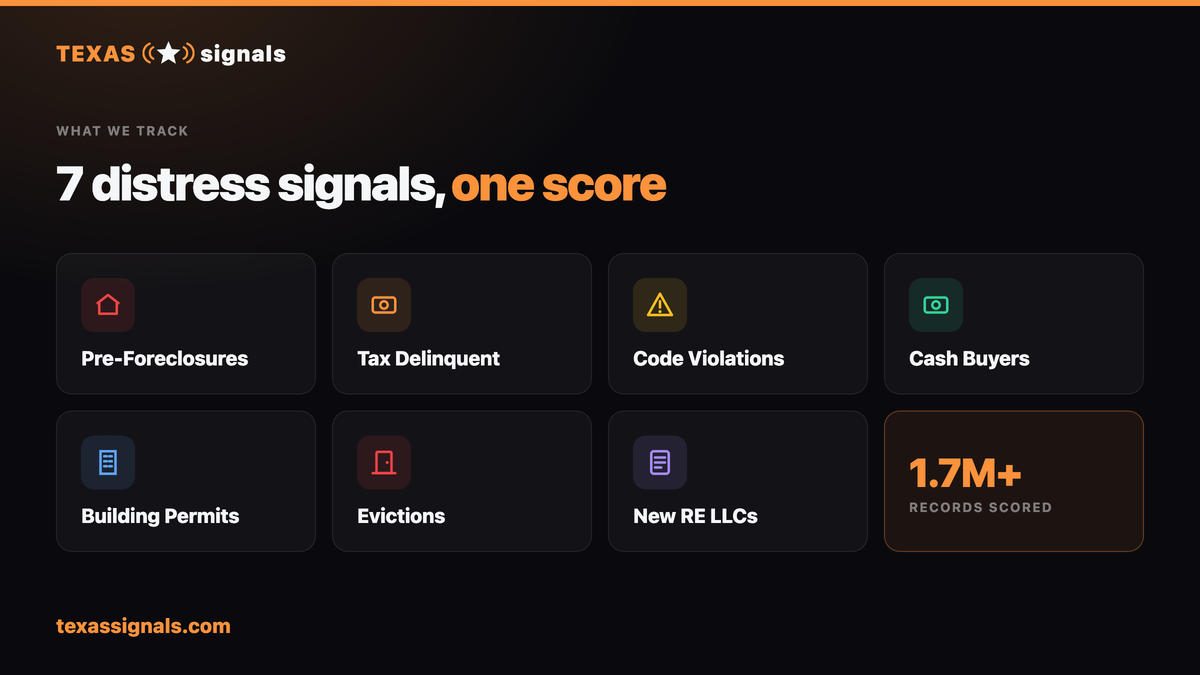
The most effective wholesale deal-finding strategy layers multiple data sources to identify properties with stacked distress signals. Here are the six data layers that Texas Signals tracks across seven Texas counties, and what each one tells you about a property.
1. Pre-Foreclosure Filings
When a lender files a Notice of Default or Notice of Trustee's Sale, it means the homeowner has missed enough mortgage payments that the lender is initiating the foreclosure process. This is the single strongest motivation signal in real estate: the homeowner is going to lose their property at auction if they do not act.
Texas Signals tracks 27,799 active pre-foreclosure filings across Travis, Harris, Dallas, Bexar, Tarrant, Collin, and Denton counties. Each filing includes the filing date, scheduled auction date, lender information, and outstanding balance — allowing you to calculate the equity spread before you ever pick up the phone.
The ideal wholesale pre-foreclosure target has 30% or more equity and an auction date 30-60 days out. That gives you enough time to negotiate, get the property under contract, and assign it to your buyer before the auction.
2. Tax Delinquent Properties
Homeowners who fall behind on property taxes are often in the early stages of financial distress — or they have disengaged from the property entirely. Texas property tax rates are among the highest in the nation (averaging 1.8% of assessed value), which means a homeowner who stops paying taxes accumulates a significant liability quickly.
A property with two or more years of delinquent taxes signals a motivated seller, especially when the county has initiated a tax lien foreclosure. Texas Signals tracks tax delinquency by amount owed and years delinquent, allowing you to filter for the most severely distressed properties.
3. Code Violations
Active code enforcement violations — overgrown lots, structural issues, unpermitted construction, abandoned vehicles — indicate a property that is being neglected. Owners facing accumulating violation fines on top of other financial pressure are often receptive to a quick cash offer. Code violation data is particularly valuable because it reveals physical distress that supplements the financial distress shown by foreclosure and tax data.
4. Cash Buyer Activity
This data source serves the other side of the wholesale equation: finding your end buyer. Texas Signals tracks 2,918 recent cash purchases across our coverage area. These are buyers who have demonstrated both the ability and willingness to close all-cash transactions on investment properties in specific zip codes.
When you put a property under contract in 78753, you can immediately pull a list of investors who have closed cash purchases in that zip code within the past 12 months. That is your buyer list — not a generic list of investor contacts, but a verified list of people who have actually closed deals in your exact area.
5. Building Permits
Building permit data serves as a leading indicator of neighborhood-level demand. A zip code with rising permit activity is a zip code where developers and builders believe demand is strong enough to justify new construction. For wholesalers, this validates your exit strategy: if builders are investing in the area, your end buyer can feel confident about the property's value trajectory.
Permit data also flags renovation activity. A cluster of renovation permits in a neighborhood signals gentrification or value recovery — both positive indicators for wholesale deal flow.
6. New LLC Formations
When a new LLC is formed with a registered agent address in a Texas county, and that LLC subsequently takes title to residential properties, it often indicates a new investor entering the market. New investors are frequently the most active buyers in the wholesale space — they need inventory, and they prefer the speed and simplicity of buying an already-negotiated deal from a wholesaler over doing their own direct-to-seller marketing.
How the Intelligence Score Ranks Opportunities
Tracking six data sources across seven counties produces an enormous volume of raw data. The challenge is not access to information — it is prioritization. Which of the 27,799 pre-foreclosure properties should you contact first?
The Texas Signals Intelligence Score solves this by combining all distress signals into a single number from 0 to 100. The scoring weights are designed around wholesale deal probability:
- Pre-foreclosure filing — up to 30 points (higher as auction date approaches)
- Tax delinquency — up to 25 points (scaled by amount and years owed)
- Code violations — up to 15 points (active violations weighted more heavily)
- CAD value decline — up to 15 points (3-year declining appraisal trend)
- Equity spread — up to 10 points (more equity means more room for your assignment fee)
- Entity or absentee ownership — up to 5 points
A property scoring 75 or above has multiple overlapping distress signals and a high probability of a motivated seller. In practice, focusing your outreach on properties scoring 70+ will dramatically improve your contact-to-contract ratio compared to working an unsorted list.
Building a Wholesale Pipeline With Texas Signals
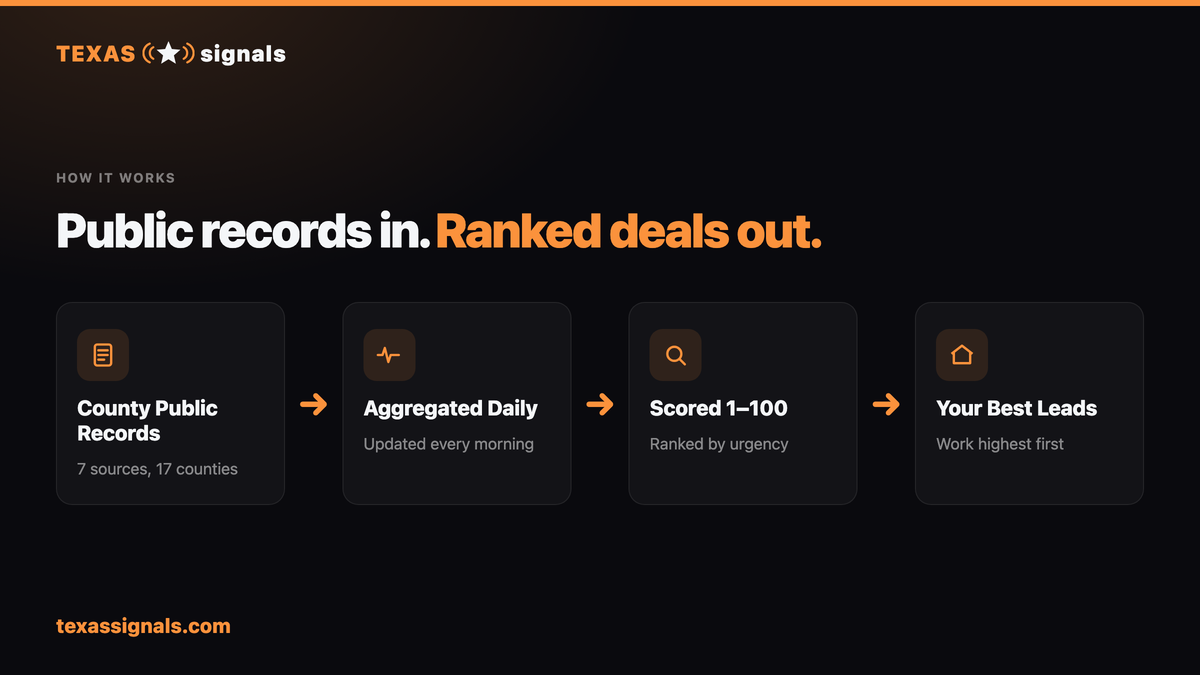
Here is a concrete workflow for building a consistent wholesale pipeline using the Texas Signals wholesaler tools.
Step 1: Define Your Buy Box
Before you start filtering data, define the parameters of deals you want to close. Which metro area? Which zip codes? What property types? What price range? What minimum equity threshold? A tight buy box lets you focus your marketing and build relationships with end buyers who want exactly the type of deals you are sourcing.
Step 2: Filter and Sort Daily
Log into the Texas Signals dashboard every morning. Filter to your target zip codes, set your minimum equity threshold (30% is a good starting point), and sort by Intelligence Score descending. The properties at the top of the list are your highest-probability targets for the day.
Step 3: Prioritize New Filings
Properties that entered the database in the last 30 days are your freshest leads. The homeowner has recently learned about the foreclosure filing and is most likely to be receptive to outreach. Properties that have been in pre-foreclosure for 90+ days have already received outreach from other investors and are harder to convert.
Step 4: Make Contact
Reach out to the homeowner through direct mail, phone, or door-knocking. Lead with empathy and information — explain that you noticed a public filing on their property and that you may be able to help them avoid the auction by purchasing the property directly. Many homeowners do not fully understand their options, and a knowledgeable, respectful approach goes further than a hard sell.
Step 5: Evaluate the Deal
Once you have a motivated seller willing to negotiate, you need to evaluate whether the numbers work for a wholesale deal. This is where most beginners get into trouble — they put properties under contract without verifying the math.
Evaluating a Wholesale Deal: The Math
Every wholesale deal comes down to a simple formula:
Maximum Allowable Offer (MAO) = ARV x 0.70 - Repair Costs - Your Assignment Fee
Let's break that down with a real example. You find a pre-foreclosure in Houston (77033) with an Intelligence Score of 82. The property is a 3-bedroom, 1,800 sq ft single-family home built in 1985. The CAD appraised value is $285,000. The outstanding mortgage balance from the foreclosure filing is $168,000.
After-Repair Value (ARV)
Pull comparable sales from the past 6 months within a half-mile radius. Similar renovated properties in 77033 are selling for $310,000-$330,000. Conservative ARV: $315,000.
Repair Costs
Based on the property age, code violation history (two active violations for exterior maintenance), and the CAD improvement value trend (declining for 2 consecutive years), estimate renovation costs at $45,000 for a standard cosmetic rehab (kitchen, bathrooms, flooring, paint, exterior).
Your Assignment Fee
A typical wholesale assignment fee in Texas metros ranges from $10,000 to $25,000 depending on deal size. Target $15,000 for this deal.
The Calculation
MAO = $315,000 x 0.70 - $45,000 - $15,000 = $220,500 - $45,000 - $15,000 = $160,500
The homeowner owes $168,000. Your maximum offer of $160,500 is below the outstanding balance, which means this deal would require a short sale approval from the lender — or you need to find a comparable property where the equity spread is wider. If the homeowner owed $140,000 instead, you could offer $160,500 and the seller walks away with $20,500 in equity rather than losing the property at auction.
This is why filtering by equity is so critical. Texas Signals shows you the estimated equity on every property, so you can identify which pre-foreclosures have enough spread to support a wholesale transaction before you spend time on outreach.
Finding Cash Buyers in Texas
The other half of wholesaling is having a reliable buyer. No matter how good your deal-finding pipeline is, you cannot close without an end buyer ready to take the assignment.
Texas Signals tracks 2,918 recent cash purchases across our seven-county coverage area. This data is pulled directly from county deed records and represents verified cash transactions — not self-reported investor lists or networking group contacts. Each cash buyer record includes the buyer's name or entity, the purchase price, the property address, and the transaction date.
The most effective way to use this data is to build zip-code-specific buyer lists. When you put a property under contract in a particular zip code, pull the list of cash buyers who have purchased in that same zip code within the past 12 months. These buyers have already demonstrated demand for properties in your target area, at price points similar to your deal. That is a far more qualified buyer list than a general investor meetup contact list.
For detailed strategies on using cash buyer data as market intelligence, see our dedicated guide.
Common Mistakes to Avoid
Over-Estimating ARV
The most expensive mistake in wholesaling is putting a property under contract at a price your end buyer will not pay. Always use conservative comparable sales, account for market softness, and leave enough room for your buyer to make their profit. If you are not sure about the ARV, order a broker price opinion or consult with an agent who works the area.
Ignoring Title Issues
A property in pre-foreclosure may have multiple liens: the primary mortgage, junior liens, mechanic's liens, IRS liens, and HOA assessments. Run a preliminary title search before making an offer. A deal with $50,000 in equity on paper might have $30,000 in junior liens that eat into your spread.
Working Stale Data
Pre-foreclosure data has a shelf life. A list that is two weeks old has already been worked by multiple investors. This is why daily data updates matter — the wholesaler who contacts a homeowner within 48 hours of the filing has a significant advantage over someone working a monthly data pull.
Get Started With Texas Signals
Texas Signals gives wholesalers the complete data infrastructure for finding deals in the Texas market: 27,799 pre-foreclosure records, tax delinquency data, code violations, cash buyer lists, building permits, and Intelligence Scores — all updated daily across seven counties. The wholesaler-specific tools are designed for exactly this workflow.
Start your 7-day free trial and run your first filtered search today. See which properties in your target zip codes score highest for wholesale deal probability.